Artificial intelligence may not be eliminating jobs at the speed many headlines predicted. Instead, The Silent Co-Worker is quietly emerging inside organisations, reshaping how work gets done task by task.
Something more subtle is happening.
AI is moving into organisations task by task.
Employees are using language models to analyse spreadsheets, draft executive summaries, conduct research, write client communications and generate code. Often there is no formal announcement, no restructuring programme and no new organisation chart.
The work simply changes.
That makes AI harder to see, and potentially more consequential for talent strategy
The emerging enterprise does not necessarily replace a worker with a machine. It increasingly gives the worker a silent co-worker: a system that absorbs selected tasks while the human remains accountable for the overall outcome.
The result is a shift from role-level automation to task-level automation.
And this creates a problem for leaders.
The organisation may look stable while the architecture of work is already changing.
The Silent Co-Worker: The AI Capability Gap Is Larger Than Most Organisations realise
One of the most useful distinctions in the emerging evidence is between what AI can do and what organisations are actually using it to do.
Researchers Maxim Massenkoff and Peter McCrory introduced an “observed exposure” approach that measures work-related AI utilisation rather than simply assessing theoretical model capability.
The difference is striking.
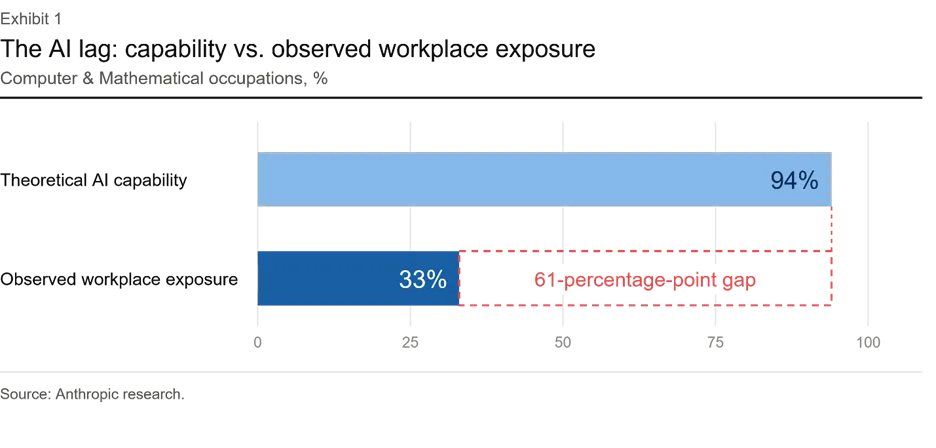
For Computer and Mathematical occupations, theoretical AI capability covers 94% of tasks, while observed workplace exposure is only 33%. That represents a 61-percentage-point gap between technological possibility and observed organisational adoption.
AI capability is not the same thing as AI adoption.
Legal requirements, data privacy, organisational inertia, software integration and the need for human verification all slow deployment.
This gap matters because leadership teams can make two opposite mistakes.
They can overestimate disruption because they see what AI could automate.
Or they can underestimate disruption because today’s headcount has not materially changed.
Both views miss the transition taking place between them.
The Silent Co-Worker: Labour Market Is Telling A More Complicated Story
The available US labour-market evidence does not show a broad surge in white-collar unemployment attributable to AI.
Analysis of Current Population Survey data from 2016 through early 2026 finds that unemployment among workers in the highest AI-exposure quartile has tracked closely with less-exposed workers. Following the release of ChatGPT in late 2022, the measured unemployment gap remained statistically insignificant.
But beneath that stability is a more tentative signal.
For workers aged 22 to 25 entering highly AI-exposed occupations, the source reports a 14% decline in the job-finding rate compared with pre-2022 baselines. The finding is suggestive rather than conclusive, and the research reports no equivalent hiring decline among workers older than 25.
This changes the question.
The issue may not initially be:
“How many people will AI replace?”
It may be:
“Where will organisations stop creating opportunities for people to become experienced professionals?”
That distinction matters enormously for talent leaders.
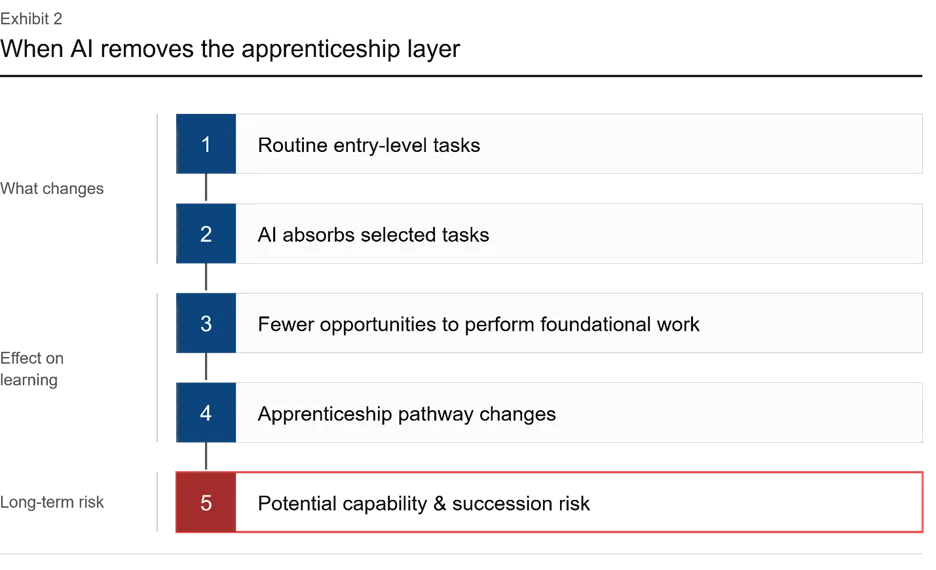
Entry-level work has traditionally provided an apprenticeship layer of professional careers. Junior employees perform routine analytical and administrative work, learn the domain, observe experienced colleagues and gradually develop judgement.
If AI absorbs much of that work, organisations cannot simply remove the tasks and assume the development pathway will remain intact.
The strategic risk is that automating entry-level tasks without redesigning career-entry pathways could weaken the traditional apprenticeship model and, over time, affect the pipeline through which organisations develop experienced professionals.
That is not a conventional workforce-reduction problem.
It is a workforce formation problem.
The People Most Exposed Are Not Necessarily The Least Skilled
Another assumption deserves reconsideration.
AI exposure is not concentrated only among low-skilled workers.
The research shows that graduate-degree holders represent 17.4% of the highest-exposure quartile, compared with 4.5% among workers with zero observed exposure. High-exposure professionals also earn an average of $32.69 per hour, compared with $22.23 among unexposed workers.
The occupational pattern reinforces the point.
Computer programmers show 74.5% observed task exposure. Customer service representatives show 70.1%. Data entry keyers show 67.1%. Market research analysts show 64.8%, while financial analysts show 57.2%.
These are not simply jobs at the bottom of the organisational hierarchy.
Many are knowledge-intensive occupations.
Education and professional status do not automatically protect a role from cognitive task automation. In some cases, they place workers closer to the frontier of AI exposure.
Why Partial Automation Has Not Produced Mass Layoffs
There is an important economic reason why high task exposure does not automatically translate into job elimination.
Many professional jobs consist of interdependent tasks.
AI may automate many activities within a role while the remaining work still depends on human judgement, negotiation, relationships, accountability or decision-making.
The research describes this through an O-Ring automation framework: when critical tasks remain dependent on human performance, automating other tasks can increase a person’s productivity rather than eliminate the position.
This helps explain the apparent contradiction:
High AI exposure can coexist with stable employment.
The contradiction disappears when we stop treating jobs as indivisible units.
A job is a bundle of tasks.
AI is attacking the bundle selectively.
The Silent Co-Worker: The Real Talent Risk May Be Hiding At The Bottom Of The Funnel
For talent acquisition, this is where the issue becomes particularly important.
But there is a second-order consequence.
Where does the next generation of experienced talent come from?
The junior engineer who once spent years performing foundational analysis.
The analyst who learned the business by preparing recurring reports.
The finance professional who developed judgement through routine financial work.
Those developmental tasks may be precisely the ones AI can perform most easily.
Removing them without replacing their developmental function creates a gap between work elimination and capability creation.
That is a much more difficult problem to see on a quarterly workforce report.
The Silent Co-Worker: Other Hidden Problem Is The AI Lag
The 94% versus 33% comparison points to another strategic issue.
Organisations may possess access to technology that employees are capable of using, while formal systems, policies and governance prevent that capability from being fully deployed.
When this happens, employees may turn to unapproved consumer tools.
The research identifies the resulting risks: data privacy exposure, compliance vulnerabilities and fragmented operating standards across departments.
This creates an uncomfortable paradox.
An organisation can simultaneously be:
overestimating AI disruption and underusing AI.
Leadership may fear that AI will radically reduce headcount while the organisation has not yet built the governance, integration and operating model required to capture much of the technology’s available value.
Closing that gap is therefore not simply an IT exercise.
It is an organisational design issue.
Workforce Planning Needs A Different Unit Of Analysis
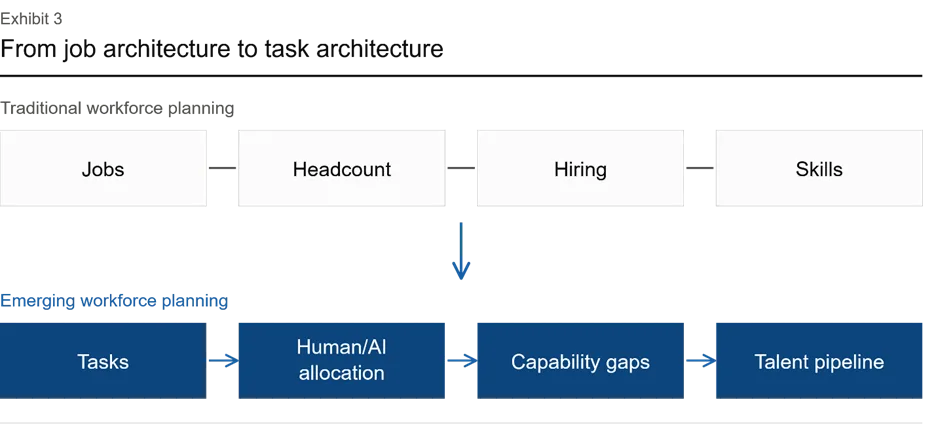
The conventional workforce question is:
How many people do we need?
The emerging question is more granular:
The World Economic Forum’s Future of Jobs Report 2025 points toward this broader shift. Employers currently attribute approximately 47% of task execution to humans alone, 22% to technology and 30% to human-machine collaboration. By 2030, employers expect a near-even distribution of 33% human-only, 34% technology and 33% collaborative task execution.
Whether those projections materialise exactly is less important than the direction they represent.
The unit of workforce planning is moving closer to the Task.
That has consequences for job architecture, recruitment, learning, succession planning and organisational design.
What Should Leaders Do Differently?
Four shifts follow directly from the evidence.
1. Audit tasks, not just jobs.
A job title tells you very little about which parts of the work are actually exposed to AI.
Organisations need task-level assessments that distinguish between automated, augmented and human-only activities.
2. Redesign entry-level work rather than simply reducing it.
If routine tasks disappear, junior roles need new developmental content.
Human-in-the-loop validation, output auditing, analytical reasoning and AI supervision can become part of the apprenticeship model.
The question is not simply how to automate junior work.
It is how to preserve the learning function that junior work historically provided.
3. Treat the AI lag as an organisational problem.
Legal, risk, compliance and technology teams need clear pathways for approved AI use, data protection and human verification.
The objective is not unrestricted adoption. It is controlled adoption that reduces shadow-IT risk while allowing useful applications to scale.
4. Reskill around the new division of work.
The WEF data indicates that 73% of employers plan to accelerate process automation and 63% intend to augment their workforce with new technologies. The associated capability priorities include analytical thinking, technology literacy and system management.
These are not simply technology skills.
They are skills for working with technology as part of the job itself.
The Silent Co-Worker Changes What Talent Strategy Is Supposed To Manage
The most important shift may therefore be conceptual.
Talent strategy has traditionally been built around jobs, people and organisational structures.
AI introduces another layer:
Tasks.
Tasks determine where automation can occur.
Tasks determine where augmentation creates leverage.
Tasks determine which entry-level activities disappear.
And tasks determine which human capabilities become more valuable.
That means a stable headcount can coexist with a profoundly changing workforce.
A department can have the same number of employees while its work has been redistributed between people and machines.
A hiring plan can remain numerically intact while the developmental pathway underneath it has weakened.
And an organisation can have access to sophisticated AI while capturing only a fraction of its potential because institutional friction prevents deployment.
The “silent co-worker” is therefore not simply an AI story.
It is a talent architecture story.
The organisations that understand this shift will not ask only how many jobs AI might eliminate.
They will ask a more useful question:
What work should humans continue to do, what work should machines perform, and how do we build the talent pipeline that connects the two?
That is where the real workforce transformation begins.
- Massenkoff, M., & McCrory, P. (2026). Labor market impacts of AI: A new measure and early evidence. Anthropic Research
- World Economic Forum. (2025). Future of Jobs Report 2025 (Insight Report). World Economic Forum
- Mohanty, D. (2026, March 9). Is your job in the red zone? The Anthropic AI chart shows which careers are changing. India Today
- Garg, A. (2026, March 7/11). Anthropic data reveals 22 career options that remain safe from AI. India Today

is a Workforce & Resourcing Strategist with 28 years of experience across Oil & Gas, EPC, and project-driven engineering environments in India, the Middle East, and the Asia Pacific. Over his career, he has placed over 12,000 professionals and led resourcing strategies for Tier-1 global clients, including Saudi Aramco, ADNOC, Qatar Energy, ExxonMobil, BP, Chevron, Woodside, and TotalEnergies. He currently leads Talent Acquisition & Resourcing for India at a global EPC major, managing workforce strategy across a 16+ project portfolio spanning FEED, Detailed Engineering, and EPC phases. Through ajayable.com, Ajay shares field-tested thinking on workforce strategy, delivery risk, skills-first hiring, AI in recruitment, and contract workforce management — grounded in real project environments rather than theory. Connect with him on LinkedIn.
Leave a Reply