The Workforce Readiness Bottleneck now stands between capital investment and real economic return. Global spending on AI infrastructure is racing toward $1.3 trillion, yet human capability lags behind. The gap is not technical. It sits in the workforce’s ability to apply, supervise, and trust these systems.
I believe this imbalance defines the next decade. Without closing it, organisations risk building advanced systems that fail in execution. Productivity gains stay theoretical. Automation becomes a substitute for missing talent rather than a driver of value.
Workforce Readiness Bottleneck and the Four Economic Futures
Talent readiness determines which version of 2030 emerges.
The future splits along a simple axis: technological progress and workforce readiness. When both rise together, productivity expands, and new roles emerge. When readiness lags, the outcome shifts toward displacement and instability.
Consider the contrast. In a high-readiness environment, workers act as orchestrators of intelligent systems. In a low-readiness one, firms automate out of necessity, not strategy. The result is uneven growth, rising unemployment, and weakened demand.
63% of employers cite skills gaps as the primary barrier to transformation.
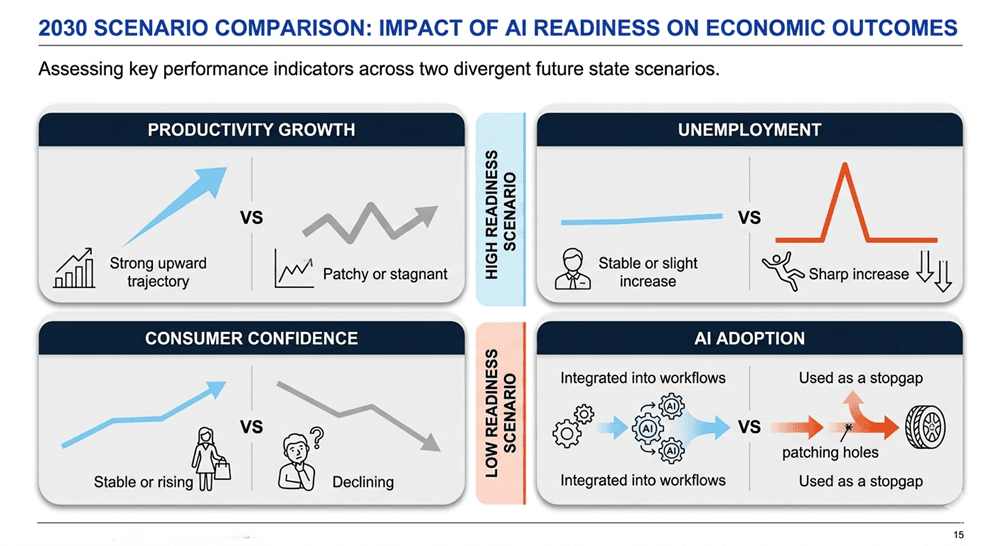
2030 Scenario Comparison
Workforce Readiness Bottleneck Is a Skills Problem and a Mindset Problem
The shortage is not only technical. It is behavioural.
The shift in required skills is clear. Routine cognitive work declines in value. Human judgment rises. Employers now prioritise analytical thinking, resilience, leadership, and curiosity alongside AI literacy.
What stands out is the rise of behavioural capabilities. Resilience and adaptability rank among the fastest-growing priorities. This signals a deeper issue. Resistance to change slows adoption as much as skill gaps do.
Demand for AI literacy has grown by 70% in a single year.
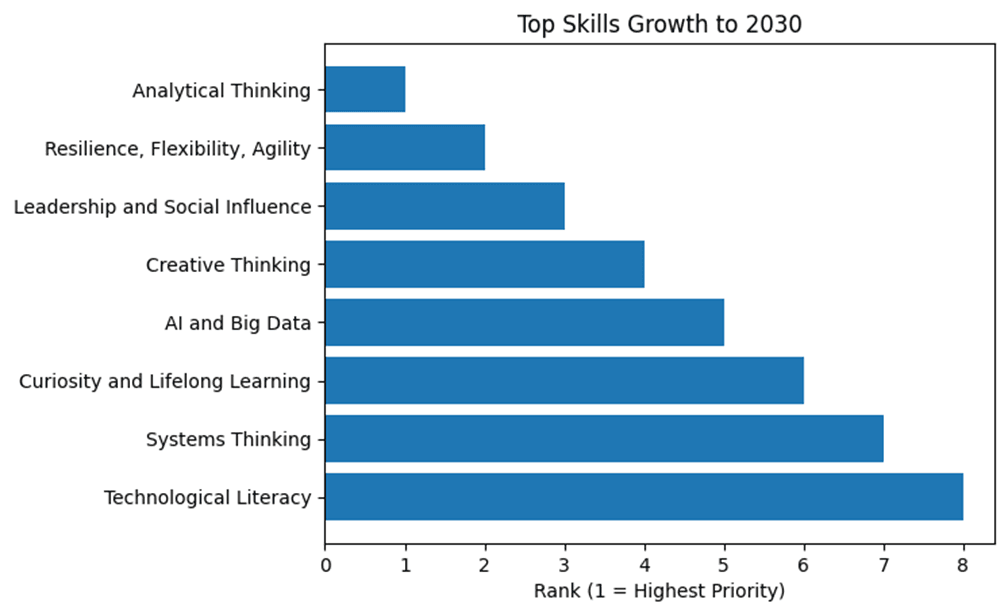
Top Skills Growth to 2030
The Workforce Readiness Bottleneck Is Blocking the Agentic Shift
AI systems advance. Human oversight struggles to keep pace.
The next phase of AI moves beyond tools into autonomous agents. These systems execute multi-step tasks with limited intervention. This raises the stakes for human oversight.
Managers shift from execution to validation. They review outputs, interpret risks, and guide decision flows. Without AI fluency, this model breaks down. Errors scale quickly. Blind spots expand.
I believe the defining role of the next decade is the “agent orchestrator.” Yet supply remains thin. Traditional education systems fail to produce cross-functional, adaptive talent at scale. Organisations must build this capability internally.
Structural Barriers Are Reinforcing the Workforce Readiness Bottleneck
Skills gaps persist because deeper constraints remain unaddressed.
Training alone does not solve the problem. Structural barriers slow progress across industries. Cultural resistance, outdated regulation, and weak infrastructure all play a role.
A pattern emerges. Many firms prioritise automation over augmentation. They replace tasks instead of redesigning workflows. This leads to fragile systems that struggle in complex environments.
46% of employers cite resistance to change as a major barrier.
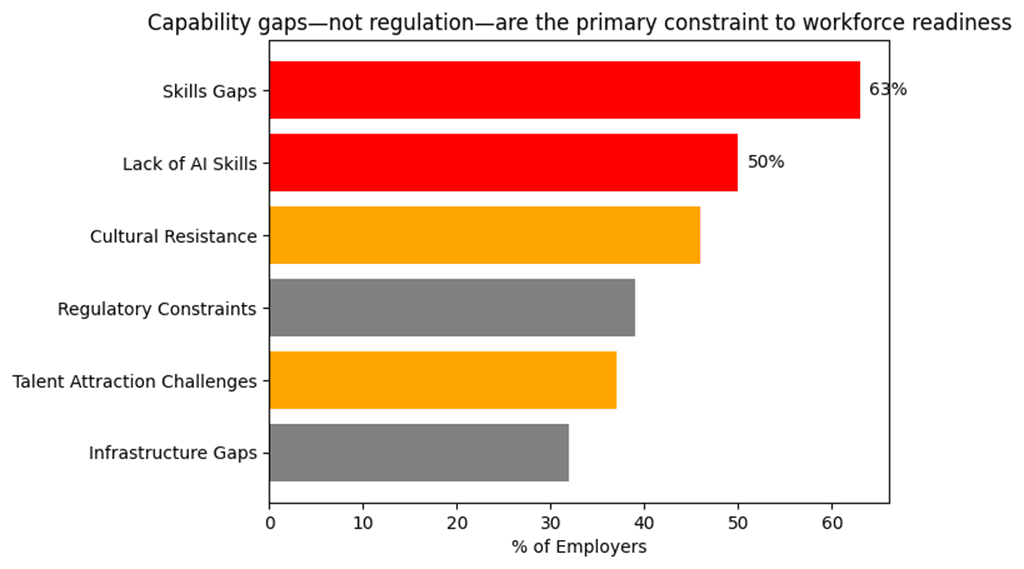
Barriers to Workforce Readiness
Closing the Workforce Readiness Bottleneck Requires Strategic Alignment
Technology investment must match human investment.
Organisations that move ahead share one trait. They align talent and technology strategies. AI initiatives no longer sit within isolated functions. They connect directly to workforce planning.
Workflow redesign becomes central. In pharmaceuticals, AI reduces report drafting time by 60% and cuts errors by half. The human role shifts toward judgment and compliance.
This pattern repeats across sectors. Value comes from collaboration between human insight and machine capability, not substitution.
A Practical Framework to Break the Workforce Readiness Bottleneck
Execution demands disciplined, organisation-wide action.
Leaders need a clear playbook. The following moves stand out:
- Embed learning into daily work rather than separate training programs.
- Build internal mobility pathways across roles and functions.
- Design workflows that combine generational strengths.
- Encourage controlled experimentation with low-risk failure.
- Use AI to reduce bias and expand access to talent pools.
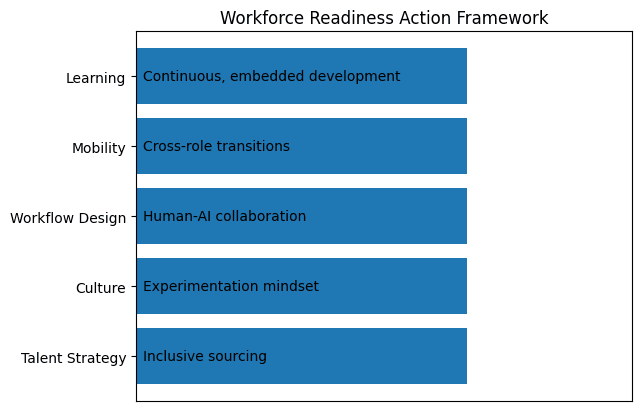
Workforce Readiness Action Framework
Here’s What I Think
The Workforce Readiness Bottleneck is not a constraint imposed by technology. It reflects leadership choices.
One path leads to displacement. Firms automate aggressively, reduce labour costs, and weaken long-term demand. The other path leads to progress. Organisations invest in people, build capability, and expand value creation.
I believe the winners of 2030 will treat human capital with the same intensity as financial capital. The task for leaders has shifted. It is no longer about digitising operations. It is about orchestrating human and machine capability at scale.
Start with a simple question. What skills does your best employee need to lead intelligent systems? The answer defines your readiness.
The wall is not moving. The question is whether your organisation is prepared to climb it.
Sources of Insights:
Four Futures for Jobs in the New Economy: AI and Talent in 2030
The Future of Jobs Report 2025
Agents, robots, and us: Skill partnerships in the age of AI

is a Workforce & Resourcing Strategist with 28 years of experience across Oil & Gas, EPC, and project-driven engineering environments in India, the Middle East, and the Asia Pacific. Over his career, he has placed over 12,000 professionals and led resourcing strategies for Tier-1 global clients, including Saudi Aramco, ADNOC, Qatar Energy, ExxonMobil, BP, Chevron, Woodside, and TotalEnergies. He currently leads Talent Acquisition & Resourcing for India at a global EPC major, managing workforce strategy across a 16+ project portfolio spanning FEED, Detailed Engineering, and EPC phases. Through ajayable.com, Ajay shares field-tested thinking on workforce strategy, delivery risk, skills-first hiring, AI in recruitment, and contract workforce management — grounded in real project environments rather than theory. Connect with him on LinkedIn.