• Skip to primary navigation
  • Skip to main content
  • Skip to primary sidebar
  • Privacy Policy
  • Terms and Conditions
  • Contact

ajayable

Where Workforce Strategy Meets Project Delivery. Insights from 28 years in Oil & Gas, EPC & Engineering.

  • Home
  • Discover Talent Trends
    • Recruitment Market Trends
    • Talent Acquisition Strategies
    • AI & Automation in Recruitment
    • Technical HR
    • Leadership & Workforce Strategy
    • Career Development for HR Professionals
  • Trending Insights
    • Global Hiring Trends: Seizing Opportunities for Workforce Evolution
    • Navigating the Recruitment Frontier: Top Talent Trends Shaping 2025 and Beyond.
    • AI in Talent Acquisition: Revolutionizing Recruitment for 2025 and Beyond.
    • Beyond the Cubicle: The Future of Work is Flexible
    • AI in HR: A Strategic Framework for Digital Transformation.
  • About Ajay
Home » AI & Automation in Recruitment » AI & Automation in TA

AI & Automation in TA

The Silent Co-Worker: AI Is Reshaping Talent Before It Reshapes Jobs

October 6, 2026 by ajay dhage 1 Comment

The Silent Co-Worker: AI Is Reshaping Talent Before It Reshapes Jobs

Artificial intelligence may not be eliminating jobs at the speed many headlines predicted. Instead, The Silent Co-Worker is quietly emerging inside organisations, reshaping how work gets done task by task.

Something more subtle is happening.

AI is moving into organisations task by task.

Employees are using language models to analyse spreadsheets, draft executive summaries, conduct research, write client communications and generate code. Often there is no formal announcement, no restructuring programme and no new organisation chart.

The work simply changes.

That makes AI harder to see, and potentially more consequential for talent strategy

The emerging enterprise does not necessarily replace a worker with a machine. It increasingly gives the worker a silent co-worker: a system that absorbs selected tasks while the human remains accountable for the overall outcome.

The result is a shift from role-level automation to task-level automation.

And this creates a problem for leaders.

The organisation may look stable while the architecture of work is already changing.

The Silent Co-Worker: The AI Capability Gap Is Larger Than Most Organisations realise

One of the most useful distinctions in the emerging evidence is between what AI can do and what organisations are actually using it to do.

Researchers Maxim Massenkoff and Peter McCrory introduced an “observed exposure” approach that measures work-related AI utilisation rather than simply assessing theoretical model capability.

The difference is striking.

For Computer and Mathematical occupations, theoretical AI capability covers 94% of tasks, while observed workplace exposure is only 33%. That represents a 61-percentage-point gap between technological possibility and observed organisational adoption.
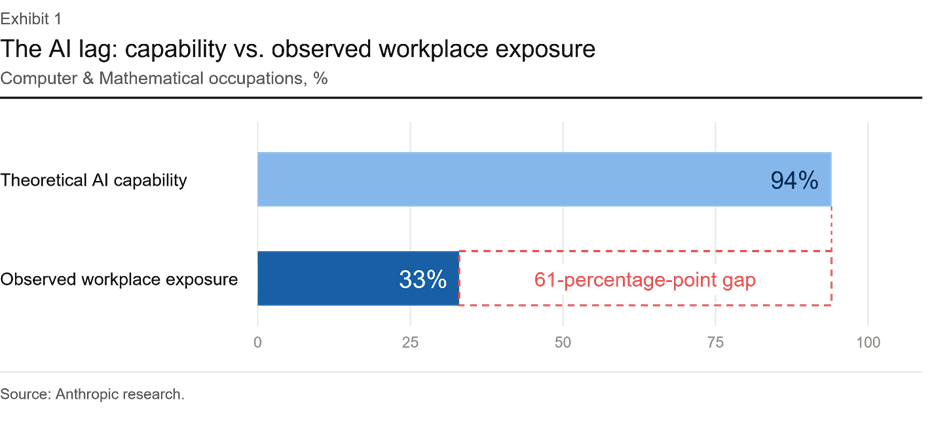
The AI Capability Gap Is Larger Than Most Organisations Realise

AI capability is not the same thing as AI adoption.

Legal requirements, data privacy, organisational inertia, software integration and the need for human verification all slow deployment.

This gap matters because leadership teams can make two opposite mistakes.

They can overestimate disruption because they see what AI could automate.

Or they can underestimate disruption because today’s headcount has not materially changed.

Both views miss the transition taking place between them.

The Silent Co-Worker: Labour Market Is Telling A More Complicated Story

The available US labour-market evidence does not show a broad surge in white-collar unemployment attributable to AI.

Analysis of Current Population Survey data from 2016 through early 2026 finds that unemployment among workers in the highest AI-exposure quartile has tracked closely with less-exposed workers. Following the release of ChatGPT in late 2022, the measured unemployment gap remained statistically insignificant.

But beneath that stability is a more tentative signal.

For workers aged 22 to 25 entering highly AI-exposed occupations, the source reports a 14% decline in the job-finding rate compared with pre-2022 baselines. The finding is suggestive rather than conclusive, and the research reports no equivalent hiring decline among workers older than 25.

This changes the question.

The issue may not initially be:

“How many people will AI replace?”

It may be:

“Where will organisations stop creating opportunities for people to become experienced professionals?”

That distinction matters enormously for talent leaders.

Entry-level work has traditionally provided an apprenticeship layer of professional careers. Junior employees perform routine analytical and administrative work, learn the domain, observe experienced colleagues and gradually develop judgement.

If AI absorbs much of that work, organisations cannot simply remove the tasks and assume the development pathway will remain intact.

The strategic risk is that automating entry-level tasks without redesigning career-entry pathways could weaken the traditional apprenticeship model and, over time, affect the pipeline through which organisations develop experienced professionals.
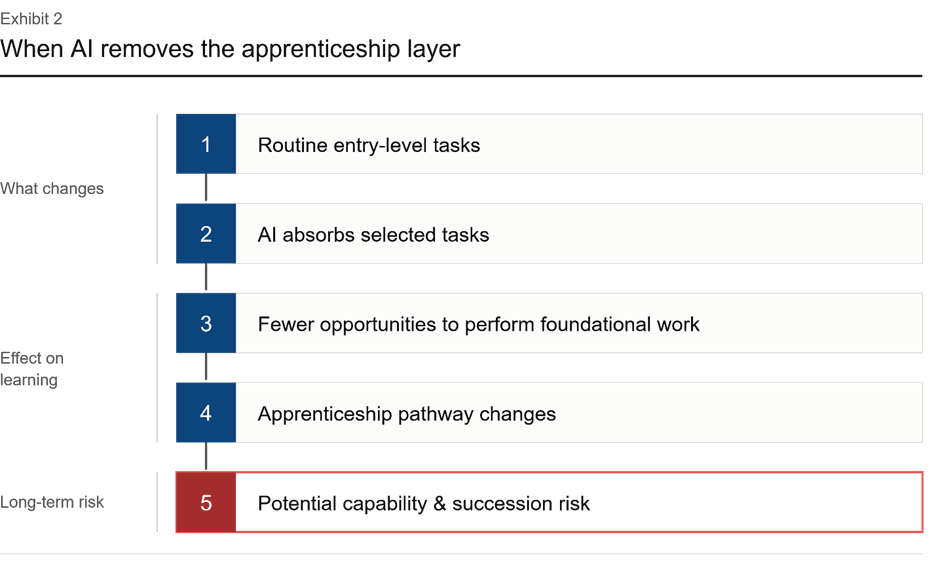
When AI removes the apprenticeship layer

That is not a conventional workforce-reduction problem.

It is a workforce formation problem.

The People Most Exposed Are Not Necessarily The Least Skilled

Another assumption deserves reconsideration.

AI exposure is not concentrated only among low-skilled workers.

The research shows that graduate-degree holders represent 17.4% of the highest-exposure quartile, compared with 4.5% among workers with zero observed exposure. High-exposure professionals also earn an average of $32.69 per hour, compared with $22.23 among unexposed workers.

The occupational pattern reinforces the point.

Computer programmers show 74.5% observed task exposure. Customer service representatives show 70.1%. Data entry keyers show 67.1%. Market research analysts show 64.8%, while financial analysts show 57.2%.

These are not simply jobs at the bottom of the organisational hierarchy.

Many are knowledge-intensive occupations.

Education and professional status do not automatically protect a role from cognitive task automation. In some cases, they place workers closer to the frontier of AI exposure.

Why Partial Automation Has Not Produced Mass Layoffs

There is an important economic reason why high task exposure does not automatically translate into job elimination.

Many professional jobs consist of interdependent tasks.

AI may automate many activities within a role while the remaining work still depends on human judgement, negotiation, relationships, accountability or decision-making.

The research describes this through an O-Ring automation framework: when critical tasks remain dependent on human performance, automating other tasks can increase a person’s productivity rather than eliminate the position.

This helps explain the apparent contradiction:

High AI exposure can coexist with stable employment.

The contradiction disappears when we stop treating jobs as indivisible units.

A job is a bundle of tasks.

AI is attacking the bundle selectively.

That is why traditional headcount metrics are becoming a weaker lens through which to understand workforce transformation.

The Silent Co-Worker: The Real Talent Risk May Be Hiding At The Bottom Of The Funnel

For talent acquisition, this is where the issue becomes particularly important.

If routine entry-level tasks disappear, organisations may initially experience less demand for some forms of routine work.

But there is a second-order consequence.

Where does the next generation of experienced talent come from?

The junior engineer who once spent years performing foundational analysis.

The analyst who learned the business by preparing recurring reports.

The finance professional who developed judgement through routine financial work.

Those developmental tasks may be precisely the ones AI can perform most easily.

Removing them without replacing their developmental function creates a gap between work elimination and capability creation.

That is a much more difficult problem to see on a quarterly workforce report.

The Silent Co-Worker: Other Hidden Problem Is The AI Lag

The 94% versus 33% comparison points to another strategic issue.

Organisations may possess access to technology that employees are capable of using, while formal systems, policies and governance prevent that capability from being fully deployed.

When this happens, employees may turn to unapproved consumer tools.

The research identifies the resulting risks: data privacy exposure, compliance vulnerabilities and fragmented operating standards across departments.

This creates an uncomfortable paradox.

An organisation can simultaneously be:

overestimating AI disruption and underusing AI.

Leadership may fear that AI will radically reduce headcount while the organisation has not yet built the governance, integration and operating model required to capture much of the technology’s available value.

Closing that gap is therefore not simply an IT exercise.

It is an organisational design issue.

Workforce Planning Needs A Different Unit Of Analysis

The conventional workforce question is:

How many people do we need?

The emerging question is more granular:

Which tasks will humans perform, which will machines perform, and where will humans and machines work together?

The World Economic Forum’s Future of Jobs Report 2025 points toward this broader shift. Employers currently attribute approximately 47% of task execution to humans alone, 22% to technology and 30% to human-machine collaboration. By 2030, employers expect a near-even distribution of 33% human-only, 34% technology and 33% collaborative task execution.

Whether those projections materialise exactly is less important than the direction they represent.

The unit of workforce planning is moving closer to the Task.

That has consequences for job architecture, recruitment, learning, succession planning and organisational design.
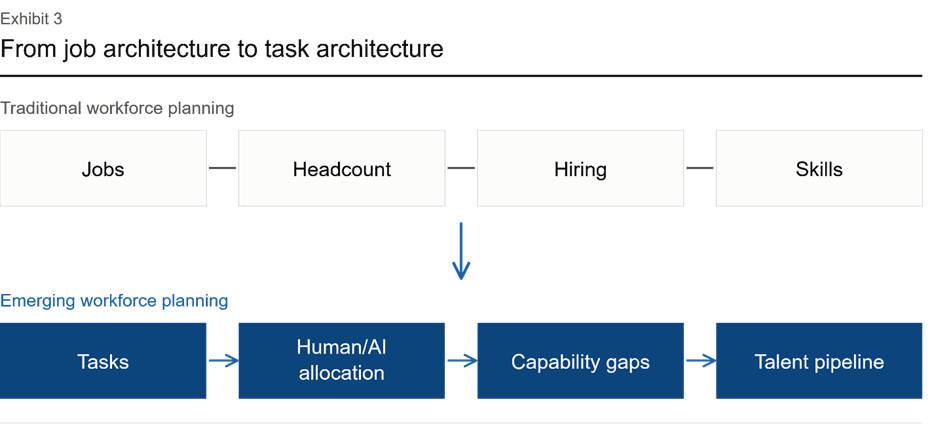
From job architecture to task architecture

What Should Leaders Do Differently?

Four shifts follow directly from the evidence.

1. Audit tasks, not just jobs.

A job title tells you very little about which parts of the work are actually exposed to AI.

Organisations need task-level assessments that distinguish between automated, augmented and human-only activities.

2. Redesign entry-level work rather than simply reducing it.

If routine tasks disappear, junior roles need new developmental content.

Human-in-the-loop validation, output auditing, analytical reasoning and AI supervision can become part of the apprenticeship model.

The question is not simply how to automate junior work.

It is how to preserve the learning function that junior work historically provided.

3. Treat the AI lag as an organisational problem.

Legal, risk, compliance and technology teams need clear pathways for approved AI use, data protection and human verification.

The objective is not unrestricted adoption. It is controlled adoption that reduces shadow-IT risk while allowing useful applications to scale.

4. Reskill around the new division of work.

The WEF data indicates that 73% of employers plan to accelerate process automation and 63% intend to augment their workforce with new technologies. The associated capability priorities include analytical thinking, technology literacy and system management.

These are not simply technology skills.

They are skills for working with technology as part of the job itself.

The Silent Co-Worker Changes What Talent Strategy Is Supposed To Manage

The most important shift may therefore be conceptual.

Talent strategy has traditionally been built around jobs, people and organisational structures.

AI introduces another layer:

Tasks.

Tasks determine where automation can occur.

Tasks determine where augmentation creates leverage.

Tasks determine which entry-level activities disappear.

And tasks determine which human capabilities become more valuable.

That means a stable headcount can coexist with a profoundly changing workforce.

A department can have the same number of employees while its work has been redistributed between people and machines.

A hiring plan can remain numerically intact while the developmental pathway underneath it has weakened.

And an organisation can have access to sophisticated AI while capturing only a fraction of its potential because institutional friction prevents deployment.

The “silent co-worker” is therefore not simply an AI story.

It is a talent architecture story.

The organisations that understand this shift will not ask only how many jobs AI might eliminate.

They will ask a more useful question:

What work should humans continue to do, what work should machines perform, and how do we build the talent pipeline that connects the two?

That is where the real workforce transformation begins.


Sources of Insights

  1. Massenkoff, M., & McCrory, P. (2026). Labor market impacts of AI: A new measure and early evidence. Anthropic Research
  2. World Economic Forum. (2025). Future of Jobs Report 2025 (Insight Report). World Economic Forum
  3. Mohanty, D. (2026, March 9). Is your job in the red zone? The Anthropic AI chart shows which careers are changing. India Today
  4. Garg, A. (2026, March 7/11). Anthropic data reveals 22 career options that remain safe from AI. India Today

ajay dhage

is a Workforce & Resourcing Strategist with 28 years of experience across Oil & Gas, EPC, and project-driven engineering environments in India, the Middle East, and the Asia Pacific. Over his career, he has placed over 12,000 professionals and led resourcing strategies for Tier-1 global clients, including Saudi Aramco, ADNOC, Qatar Energy, ExxonMobil, BP, Chevron, Woodside, and TotalEnergies. He currently leads Talent Acquisition & Resourcing for India at a global EPC major, managing workforce strategy across a 16+ project portfolio spanning FEED, Detailed Engineering, and EPC phases. Through ajayable.com, Ajay shares field-tested thinking on workforce strategy, delivery risk, skills-first hiring, AI in recruitment, and contract workforce management — grounded in real project environments rather than theory. Connect with him on LinkedIn.

ajayable.com

Filed Under: AI & Automation in Recruitment, AI & Automation in TA Tagged With: AI recruitment, AI recruitment trends, Recruitment automation, recruitment trends, Workforce planning

Agentic AI for Proactive Sourcing: Shaping the Future of Talent Acquisition

April 19, 2025 by ajay dhage Leave a Comment

Agentic AI for Proactive Sourcing: Shaping the Future of Talent Acquisition

The relentless tide of hiring, with its cyclical ebbs and flows, is a familiar landscape for any recruiter. Just when one role is filled, another emerges, and the quest for the ideal candidate often feels like an unending marathon.

The frustration of a promising candidate backing out or simply vanishing adds another layer of complexity. Even with existing AI tools integrated into the recruitment process, the fundamental responsibility of keeping everything on track still rests heavily on human shoulders.

But what if the most time-consuming and repetitive aspects of talent acquisition, such as the initial stages of candidate identification and engagement, could operate autonomously in the background? This is no longer a distant dream; it’s the burgeoning reality powered by agentic AI for Proactive Sourcing.

Imagine a scenario where, instead of reacting to immediate hiring needs, your talent acquisition strategy becomes inherently forward-thinking.

This is the promise of agentic AI for Proactive Sourcing: intelligent systems that don’t just wait for instructions but actively anticipate future needs and cultivate relationships with potential candidates before a vacancy even arises.

These AI agents adapt in real-time, take initiative, and free recruiters to concentrate on higher-level strategic initiatives and the crucial human element of hiring.

What once seemed like a concept confined to science fiction is now seamlessly integrating into the daily workflows of leading talent acquisition teams.

Indeed, agentic AI in talent acquisition isn’t a future possibility—it’s unequivocally here, fundamentally reshaping how organizations source, screen, and ultimately hire talent at scale.

Decoding Agentic AI: The Engine Behind Proactive Sourcing

To truly grasp the transformative potential of agentic AI for Proactive Sourcing, it’s crucial to understand what sets it apart from its predecessors.

AI agents are essentially sophisticated programs leveraging agentic AI, a more evolved form of artificial intelligence engineered to pursue objectives without the need for constant human input.

While agentic AI embodies the intelligence that drives adaptability and decision-making, AI agents are the tangible tools that apply this intelligence to real-world recruitment tasks.

Unlike conventional AI tools that passively await a prompt or rigidly adhere to pre-defined rules, AI agents are inherently goal-driven.

They possess the capacity to make independent decisions, adjust their operational behaviour based on the outcomes they observe, and continuously refine their approach to achieving hiring objectives.

In the context of recruiting, this signifies a paradigm shift. Agentic AI for Proactive Sourcing transcends the basic functionalities of merely sorting resumes or drafting standard emails.

Instead, these intelligent agents can proactively and autonomously search for potential candidates who might be a fit for future roles, initiate personalized outreach to gauge their interest, and even begin the initial stages of engagement – all without direct, step-by-step human guidance.

Several key characteristics distinguish Agentic AI for Proactive Sourcing :

  • Autonomy: AI agents operate with minimal need for direct human intervention. They can independently source candidates, initiate contact, and progress through preliminary tasks. This autonomy is pivotal for proactive sourcing, allowing the continuous identification and engagement of talent in the background.
  • Decision-making: These systems analyze vast amounts of candidate data, prioritize outreach efforts based on potential fit for future needs, and can even pivot their strategies based on their ongoing interactions and data analysis. This intelligent decision-making is crucial for effective proactive sourcing, ensuring that efforts are focused on the most promising individuals.
  • Adaptability: As they accumulate feedback from recruiters and observe candidate behaviour, AI agents learn and progressively enhance their ability to achieve hiring goals. This learning capability is invaluable for proactive sourcing, enabling AI to refine its understanding of ideal future candidates over time.

The evolution of AI in talent acquisition has been a progressive journey. We began with rudimentary machine learning capable of identifying patterns in data. Then emerged generative AI, which could generate content like job descriptions. Now, agentic AI for Proactive Sourcing represents the next significant leap – a phase where technology actively takes initiative and drives the talent acquisition process forward, particularly in anticipating future needs.

The Dichotomy: Agentic AI vs. Traditional AI in the Proactive Sourcing Realm

Until recently, AI in recruiting primarily served as a support system for isolated tasks, such as identifying potential candidates for immediate openings, drafting job advertisements, and sending automated follow-up messages. Tools powered by machine learning or generative AI have undoubtedly been beneficial, but their capabilities have been inherently limited. They are fundamentally reactive, responding to specific inputs rather than proactively driving the process.

Agentic AI for Proactive Sourcing operates on a fundamentally different principle: proactivity. Instead of passively waiting for prompts, these intelligent agents take the initiative to accomplish tasks and make headway in your workflow, particularly in anticipating future talent needs.

Consider the task of identifying potential candidates for a role that might open in the next six months.

A traditional AI tool might analyze past hiring data for similar roles and recommend candidates based on static filters like years of experience or location. While helpful, this approach is still reactive.

Agentic AI for Proactive Sourcing, however, can go several steps further. It can continuously scan various talent pools, identify individuals with emerging skill sets that will be crucial in the future, initiate introductory conversations to gauge their potential interests and long-term career aspirations, and even flag these individuals in a talent pipeline for proactive engagement when the need becomes more immediate.

The contrast becomes even clearer when considering candidate engagement. While generative AI can assist in drafting a follow-up message to a candidate who expressed interest in a past role, an AI agent focused on proactive sourcing can maintain ongoing, personalized communication with promising future candidates, sharing relevant company updates, industry insights, and potential future opportunities. This sustained engagement helps build relationships and keeps the organization top-of-mind for these individuals when they eventually become open to new opportunities.

Think of generative AI as a highly capable assistant executing specific tasks upon request. In contrast, agentic AI for Proactive Sourcing acts more like a strategic partner, autonomously navigating the talent landscape to identify and nurture relationships with individuals who align with the organization’s future talent trajectory.

In essence, while machine learning and generative AI offer valuable support for specific recruiting tasks, agentic AI actively does the work of anticipating and preparing for future talent needs.

This fundamental shift frees up human recruiters to dedicate less time to the initial, often tedious, stages of sourcing and more time to cultivating meaningful relationships with high-potential candidates and making strategic hiring decisions.

Why Agentic AI for Proactive Sourcing Marks a True Breakthrough

The market has seen numerous AI tools promising to simplify recruiting, often adding superficial shortcuts while leaving the core burden of managing a lengthy list of tasks unchanged. Agentic AI for Proactive Sourcing represents a genuine breakthrough because it fundamentally reshapes how you approach talent acquisition, rather than merely accelerating existing processes. From the moment of implementation, the entire workflow for anticipating and addressing future talent needs looks and feels distinctly different.

With agentic AI actively engaged in proactive sourcing, several key shifts occur:

No More Micromanaging Tools for Future Talent Pools:

AI agents designed for proactive sourcing don’t require constant supervision. Once the overarching goal is defined – for example, identifying and engaging potential candidates with specific emerging skills relevant to the company’s long-term strategy – they autonomously spring into action. Recruiters are no longer manually sifting through countless profiles on various platforms or meticulously tracking potential candidate lists. The AI agent is already autonomously:

  • Searching across diverse platforms, including specialized and niche networks, to identify individuals with the desired future-oriented skill sets.
  • Initiating personalized outreach to these promising candidates, introducing the company and exploring their long-term interests.
  • Dynamically refining its search and engagement strategies based on early feedback and observed trends in the talent market. Human recruiters retain overall control but are relieved from the granular, time-intensive tasks of initial proactive identification and outreach.

More Time for Meaningful Conversations About Future Fit:

When the initial legwork of proactively identifying and engaging potential future talent is automated, Multiversed Recruiters gain invaluable time to focus on the human aspects of building relationships. Instead of being overwhelmed by the sheer volume of initial outreach and screening, they can:

  • Dedicate more time to understanding the long-term career aspirations and potential fit of proactively sourced candidates.
  • Craft highly personalized and compelling outreach that resonates with individuals based on their unique skills and future ambitions.
  • Collaborate more effectively with hiring managers to define future skill needs and tailor proactive sourcing strategies accordingly. This reclaimed time presents a significant opportunity to enhance the candidate experience for proactively sourced individuals, fostering stronger connections and building a robust pipeline for future hiring needs.

Smarter Proactive Processes Without Added Effort:

Every interaction and data point gathered by the AI agent, whether it’s a successful initial engagement or a refined understanding of emerging skill demands, feeds into its ongoing learning process.

Over time, the AI develops a deeper understanding of the organization’s evolving role requirements, industry trends, and ideal future candidate profiles.

For instance, the AI might discern that professionals with a specific combination of emerging skills in a certain geographic market are more receptive to outreach focusing on long-term career growth within the company’s innovative projects.

The AI agent will then automatically adapt its messaging and targeting strategies accordingly, without requiring any manual reprogramming or reminders.

As recruiters focus on nurturing relationships with proactively sourced candidates, a continuous improvement cycle operates seamlessly in the background, optimizing future proactive sourcing efforts.

Implementing Agentic AI for Proactive Sourcing: A Strategic Approach

Integrating agentic AI for Proactive Sourcing doesn’t necessitate a complete overhaul of your existing recruitment framework. The most effective strategy involves strategically layering it into areas where it can alleviate the most significant burden, particularly in the initial stages of identifying and engaging potential future talent. Think of an AI agent as a dedicated teammate specifically focused on building a pipeline of promising candidates for future needs.

Here’s how agentic AI can maximize its impact on proactive sourcing:

Source Smarter, Beyond the Immediate Horizon:

Even the most accomplished recruiters have limitations in terms of the time they can dedicate to sourcing, the number of platforms they can effectively search, and the volume of profiles they can thoroughly review.

AI agents in hiring can proactively source deeper and wider than any human, efficiently scanning thousands of profiles across job boards, professional networks, niche communities, and even academic research platforms to identify individuals with emerging skills and long-term potential.

Unlike traditional machine learning and generative AI models that rely on specific algorithms and prompts (like complex Boolean searches), agentic AI can evaluate career trajectories, growth patterns, and skill adjacencies to uncover strong-fit candidates for future roles who might not surface through conventional reactive methods.

Tip: When aligned with a clearly defined future skills rubric, AI agents can proactively pinpoint candidates who match the organization’s anticipated long-term needs right from the outset.

Screen Potential Future Candidates Through a Wider Lens:

Forget solely relying on keyword matching and hope your Applicant Tracking System (ATS) correctly identifies individuals with potential for future growth.

With agentic AI for Proactive Sourcing, the initial screening process becomes more intelligent and aligned with your organization’s long-term hiring objectives.

These AI systems can apply a custom “What Good Looks Like” rubric – encompassing not just current skills but also indicators of adaptability, learning agility, and experience in emerging fields – to evaluate candidates based on factors that truly matter for future success.

This might include experience with specific nascent technologies, a history of successful transitions into new domains, or participation in cutting-edge research.

As human recruiters provide feedback on which proactively sourced candidates demonstrate the most promise for future roles, the AI learns and refines its proactive identification and initial engagement strategies, ensuring that the future talent pipeline increasingly aligns with the organization’s evolving needs.

Tip: Certain AI tools can even articulate why a particular candidate was flagged as a strong potential fit for future roles, providing valuable insights and fostering confidence and compliance.

Personalize Proactive Outreach at Scale:

Maintaining personalization in candidate outreach can be challenging when done manually or using generic templates, especially when reaching out to a large pool of potential future candidates.

However, with agentic AI for Proactive Sourcing, this is no longer an insurmountable hurdle. These intelligent systems can tailor initial outreach messages to each individual, drawing upon their publicly available experience, interests, and activity across professional platforms.

The messages can be crafted to highlight potential alignment with the organization’s future direction and explore their long-term career aspirations, increasing the likelihood of a positive response.

Agentic AI can also experiment with different messaging styles, track engagement levels, and automatically follow up with individuals who show initial interest, nurturing these relationships over time.

While recruiters retain control over the core messaging, they are spared countless hours of manually researching, copying, pasting, and editing individual outreach emails for proactive sourcing.

Continuous Optimization of Proactive Sourcing Efforts:

A significant advantage of agentic AI in HR is its inherent ability to learn and evolve.

As the organization hires, passes on or provides feedback on candidates (including those proactively sourced), the system identifies patterns and automatically adjusts its proactive sourcing approach.

This ongoing learning ultimately provides recruiters with more bandwidth to focus on evaluating candidates who are a strong fit for both current and future roles.

By learning from real-world outcomes, agentic AI for Proactive Sourcing can also help mitigate unconscious bias in early-stage identification and surface candidates who might otherwise be overlooked based on conventional reactive sourcing criteria.

Whether the organization is rapidly scaling, tackling hard-to-fill future roles, or venturing into new areas requiring unfamiliar skill sets, AI agents ensure continuous progress in building a robust future talent pipeline, allowing recruiters to maintain focus on the bigger strategic picture.

Balancing Technological Prowess with Human Insight

While AI is revolutionizing recruitment, particularly in proactive sourcing, it is not intended to supplant the critical role of human recruiters. The most effective outcomes arise from a synergistic blend of the speed and agility of AI with the judgment, empathy, and extensive experience that humans bring to the talent acquisition process.

For instance, platforms like SeekOut Spot exemplify this balanced approach, where expert human recruiters collaborate closely with AI agents.

While the AI agents handle the foundational tasks of proactive sourcing, initial screening for future potential, and personalized outreach, a dedicated human recruiter interprets the results, ensures the process remains focused on identifying the right long-term fit, and cultivates deeper relationships with promising future candidates.

This collaborative model acknowledges that while AI excels at scale and efficiency, the nuanced understanding of long-term potential and cultural alignment often requires human discernment.

For many busy talent acquisition teams, dedicating the necessary time and resources to learn and effectively utilize advanced tools like agentic AI can be a significant hurdle.

Services like SeekOut Spot aim to bridge this gap by providing access to cutting-edge recruiting technology without a steep learning curve or prohibitive costs, while also offering the guidance of experienced human recruiters to steer decisions throughout the proactive sourcing and engagement process.

This collaborative partnership begins with a thorough kickoff meeting where the organization and the recruiting service align on future role requirements, defining essential skills, desirable attributes, and the broader context of long-term success.

From this foundation, the agentic AI then initiates its proactive work. It can generate a “What Good Looks Like” rubric tailored to future needs and use this as the basis for evaluating thousands of profiles, looking for deep signals of potential, including relevant experience in emerging areas, demonstrable adaptability, and patterns of continuous learning.

Following approval of this rubric, the AI autonomously conducts candidate research, broadly sourcing and evaluating potential matches for future roles at scale. Subsequently, the AI agent initiates personalized outreach with multi-step, tailored engagement to connect with these potential future candidates.

Within a relatively short timeframe, a human recruiter leverages their expertise to further screen these proactively sourced candidates for long-term fit and confirm their potential interest in future opportunities. Finally, the recruiter presents a curated slate of high-quality candidates who align with the organization’s long-term goals and are ready for continued engagement.

Putting Agentic AI into Proactive Practice

When hiring demands fluctuate, especially when anticipating future needs across multiple evolving roles with limited current bandwidth, the ability to proactively build a talent pipeline becomes paramount. Agentic AI for Proactive Sourcing is specifically designed for such scenarios. Whether facing a surge in anticipated future hiring or simply lacking the capacity to manage proactive sourcing efforts in-house, AI agents help organizations maintain agility without compromising the quality of their future talent pool.

By acting as an extension of the talent acquisition team, a dedicated human recruiter, working in tandem with AI agents, brings crucial human insight and hiring expertise to the proactive sourcing process. The AI agents handle the time-consuming tasks of initial identification, outreach, and engagement, freeing up recruiters to focus on strategic relationship building and in-depth evaluation of long-term potential.

For organizations seeking a way to proactively source deeper, screen smarter for future skills, and maintain a robust talent pipeline, exploring the capabilities of agentic AI for Proactive Sourcing is undoubtedly a worthwhile endeavour.

The Expert Consensus: Agentic AI as the Future of Talent Acquisition

The prevailing sentiment among industry experts underscores the transformative power of agentic AI in the realm of talent acquisition, particularly in enabling proactive strategies.

For years, recruitment technology has leaned on structured, often manual, processes for job boards, ATS systems, and screening tools. While automation and traditional AI have enhanced efficiency, they have largely operated within predefined rules, sorting resumes, flagging matches based on explicit criteria, and streamlining existing workflows without truly owning proactive decision-making.

Agentic AI for Proactive Sourcing shatters this paradigm. Instead of awaiting specific inputs for current roles, it intelligently scans vast data signals, dynamically adjusts talent acquisition strategies in real-time to anticipate future needs, and proactively drives recruiting processes while collaborating with recruiters to build pipelines for tomorrow.

This predictive, dynamic, and self-optimizing nature is why organizations are making significant investments in this technology.

The projected growth of agentic AI in recruitment to $23.17 billion by 2034, with a compound annual growth rate (CAGR) of 39.3%, underscores the industry’s belief in its potential.

In an increasingly competitive landscape for talent, precision and the ability to anticipate future needs are paramount.

Experts foresee a future where AI handles administrative burdens, empowering recruiters to concentrate on strategic initiatives.

Proactive sourcing will become even more sophisticated and predictive, with companies analyzing market trends and growth projections to anticipate staffing needs months in advance, positioning themselves to secure top talent even before they actively seek new opportunities.

While some caution against viewing agentic AI as a panacea for broken hiring processes, emphasizing the need to fix underlying issues first, the consensus points towards agentic AI as a pivotal advancement, moving recruitment from basic automation to true independent decision-making in areas like proactive candidate identification and engagement.

It’s crucial to approach the implementation of agentic AI strategically, focusing on gradual integration and achieving “small wins” rather than attempting wholesale replacement of human recruiters.

Those who resist embracing AI risk being left behind, as companies leveraging these technologies are already experiencing significant gains in productivity and reach.

The future of hiring is poised to be smarter, faster, and more personalized, with agentic AI actively adapting, learning, and executing recruiting tasks with minimal human intervention, freeing recruiters to focus on relationship building and enhancing candidate experiences, particularly with proactively sourced individuals.

Agentic AI has the potential to fundamentally reshape the recruitment landscape by seamlessly automating context-intensive tasks, offering transformative efficiency without sacrificing critical human oversight.

Its competitive edge lies in making real-time decisions within hiring workflows, including identifying and engaging potential future talent. While ethical considerations and robust data governance are essential, the potential is undeniable: agentic AI will redefine how organizations source, evaluate, and hire talent, setting new standards for speed, accuracy, and strategic impact, especially in the proactive domain.

Many experts believe that agentic AI will free recruiters from repetitive tasks like initial sourcing, allowing them to focus on the human side of the job, make data-driven strategic decisions, and enhance the candidate experience, including proactive engagement with potential future hires. By overhauling candidate communication through real-time updates and timely feedback, AI agents can also address the pervasive issue of “ghosting” in recruiting, fostering stronger relationships with proactively sourced candidates.

Ultimately, the prevailing view is that agentic AI will amplify the impact of recruiters, not replace them, streamlining initial outreach and allowing a greater focus on building relationships and assessing long-term human potential within proactively identified talent pools.

The best talent acquisition teams will leverage AI as a force multiplier, using predictive analytics to proactively identify top talent and craft hyper-personalized engagement strategies at scale.

I believe that agentic AI represents a significant step towards realizing the true potential of talent acquisition – moving from reactive filling of vacancies to proactive curation of exceptional talent.

For the first time, organizations can gain the capacity to truly seek out and engage the best individuals, aligning their skills with future organizational needs long before a formal position is open.

This shift moves away from the tactical busywork of traditional recruiting towards a more strategic, value-driven approach focused on building lasting relationships with future talent. Companies that embrace this evolution will gain a significant competitive advantage, while those who cling to outdated, purely reactive methods risk becoming obsolete.

Agentic AI evolves with hiring needs, continuously learning and adapting to improve matching, sourcing, and engagement as the market shifts, enabling organizations to stay ahead of the curve in anticipating and securing future talent.

This marks a shift from passive filtering of applications to active and autonomous discovery, engagement, and even initial qualification of top talent.

This evolution will accelerate hiring cycles for future roles, reduce bias in early-stage identification, and empower recruiters to concentrate on building authentic human connections with proactively sourced individuals.

In essence, agentic AI is poised to disrupt recruiting profoundly, enhancing efficiency, reducing time-to-hire for future roles, and augmenting the capabilities of recruiters who embrace this technological shift.

The consensus is clear: agentic AI for Proactive Sourcing is not a distant trend; it is a present reality.

Organizations that explore, test, and integrate these technologies today will be the leaders of tomorrow, building robust pipelines of future talent and securing a significant competitive advantage.

Those who hesitate risk being left behind in the race for top talent. Now is the opportune moment to understand how agentic AI fits into your proactive talent-sourcing strategy.

Here’s What I Think

While the current applications of agentic AI in proactive sourcing are undeniably transformative, I believe we are only scratching the surface of its potential. Here are some unique and innovative ideas that significantly diverge from the original concepts, suggesting how agentic AI could further revolutionize proactive talent acquisition:

Predictive Skill Gap Intelligence & Personalized Learning Pathways:

Imagine agentic AI not just identifying potential future candidates but also predicting emerging skill gaps within the existing workforce. Based on these predictions and the profiles of proactively sourced candidates, the AI could autonomously generate personalized learning and development pathways for both internal employees and engaged prospects. This would create a symbiotic relationship, nurturing internal talent while simultaneously preparing external candidates for future roles, creating a truly proactive and integrated talent ecosystem.

Decentralized Autonomous Recruiting Organizations (DAROs):

Envision a future where organizations leverage blockchain technology and agentic AI to create decentralized autonomous recruiting organizations. These DAROs, governed by smart contracts and powered by AI agents, could autonomously identify, engage, and even “pre-hire” talent based on the collective intelligence of the network and the specific needs of participating organizations. This would foster a more fluid and efficient talent marketplace, transcending the limitations of individual company-centric recruiting efforts.

“Talent Foresight” Platforms Integrating Macroeconomic & Geopolitical Data:

Expand the scope of agentic AI beyond individual candidate profiles. Imagine platforms that integrate real-time macroeconomic indicators, geopolitical shifts, and technological advancements to predict future industry trends and the corresponding demand for specific skill sets. This “talent foresight” capability would empower organizations to proactively source and cultivate talent pools years in advance, giving them an unprecedented advantage in securing future expertise.

AI-Driven “Talent Relationship Managers”:

Move beyond basic outreach and engagement. Develop agentic AI systems that function as true “Talent Relationship Managers,” capable of building and nurturing long-term relationships with proactively sourced candidates. These AI TRMs could understand individual career goals, provide personalized career guidance, connect candidates with relevant internal mentors, and even facilitate participation in exclusive pre-hiring communities, fostering deep connections and loyalty.

Ethical AI Guardians & Bias Prevention Networks:

Recognizing the critical importance of ethical AI, envision decentralized networks of “AI Guardians” – independent AI agents dedicated to continuously auditing and mitigating bias in recruitment algorithms across various platforms. These guardians would operate autonomously, ensuring fairness and transparency in proactive sourcing and candidate evaluation, fostering trust and accountability in the AI-driven talent acquisition landscape.

Conclusion: Embracing the Proactive Power of Agentic AI

Agentic AI for Proactive Sourcing represents a monumental leap forward in the evolution of talent acquisition.

By empowering organizations to anticipate future talent needs, autonomously identify and engage potential candidates, and cultivate long-term relationships, this technology is fundamentally reshaping how we think about building high-performing teams.

The ability to move beyond reactive hiring to a proactive, strategic approach offers unprecedented opportunities for efficiency, accuracy, and competitive advantage.

As agentic AI continues to evolve, its role in shaping the future of talent is undeniable. Organizations that embrace its power and integrate it thoughtfully into their talent acquisition strategies will be well-positioned to secure the best talent, drive innovation, and thrive in the dynamic world of work.

The future of talent acquisition is not just about filling roles; it’s about proactively building the future of your organization, powered by the intelligent autonomy of agentic AI.


Sources of insights:

  1. AI Agents for Recruiting: A Guide for Hiring Teams
  2. Agentic AI in Recruitment: Experts Share What’s Next
  3. Agentic AI, the demise of human recruiters and the race to harness data – AIM Group
  4. Beyond automation: The power of agentic AI in HR – Eightfold
  5. Agentic AI vs Traditional AI for Recruiting | hireEZ
  6. Optimizing Talent Acquisition and Screening with Agentic AI
  7. Agentic AI: Your Autonomous Partner in Modern Recruitment
  8. Are AI Agents The Future Of Recruiting?

ajay dhage

is a Workforce & Resourcing Strategist with 28 years of experience across Oil & Gas, EPC, and project-driven engineering environments in India, the Middle East, and the Asia Pacific. Over his career, he has placed over 12,000 professionals and led resourcing strategies for Tier-1 global clients, including Saudi Aramco, ADNOC, Qatar Energy, ExxonMobil, BP, Chevron, Woodside, and TotalEnergies. He currently leads Talent Acquisition & Resourcing for India at a global EPC major, managing workforce strategy across a 16+ project portfolio spanning FEED, Detailed Engineering, and EPC phases. Through ajayable.com, Ajay shares field-tested thinking on workforce strategy, delivery risk, skills-first hiring, AI in recruitment, and contract workforce management — grounded in real project environments rather than theory. Connect with him on LinkedIn.

ajayable.com

Filed Under: AI & Automation in Recruitment, AI & Automation in TA Tagged With: Agentic AI, AI in HR, AI recruitment, Automation in Recruiting, Future of work, Recruitment Technology, recruitment trends, Talent Acquisition

Primary Sidebar

Latest Reads

  • The Silent Co-Worker: AI Is Reshaping Talent Before It Reshapes Jobs
  • Why the Workforce Readiness Bottleneck Will Decide the 2030 Economy
  • The Resilience Trap: Why Age-Inclusive Talent Strategy Is the Real Competitive Advantage
  • The Hollow Organisation: Why 2026 Cost-Cutting Triggers a Leadership Pipeline Crisis by 2030
  • Recruitment Strategy 2026: Why AI, Skills, and Human Judgment Will Redefine Hiring

What Readers Say

  1. Smith Says on The Silent Co-Worker: AI Is Reshaping Talent Before It Reshapes Jobs
  2. ajay dhage on Talent Wars: Winning the Battle for Top Employees
  3. Raosaheb P Pandit on Talent Wars: Winning the Battle for Top Employees
  4. Vipul Patel on How Evolving Degree Value is Redefining Career Pathways
  5. Deep Punkar on How Evolving Degree Value is Redefining Career Pathways

Explore Topics

  • AI & Automation in Recruitment
  • AI & Automation in TA
  • AI and Automation
  • AI in Recruitment
  • Campus & Early Careers
  • Career Development for HR Professionals
  • Future of Work
  • Industry Trends
  • Leadership & Talent Strategy
  • Leadership & Workforce Strategy
  • Recruitment Market Trends
  • Talent Acquisition Strategies
  • Technical HR

Archives

  • October 2026
  • May 2026
  • February 2026
  • January 2026
  • December 2025
  • November 2025
  • October 2025
  • September 2025
  • June 2025
  • May 2025
  • April 2025
  • March 2025
  • February 2025
  • January 2025
  • December 2024

Copyright © 2026 · News Pro on Genesis Framework · WordPress · Log in