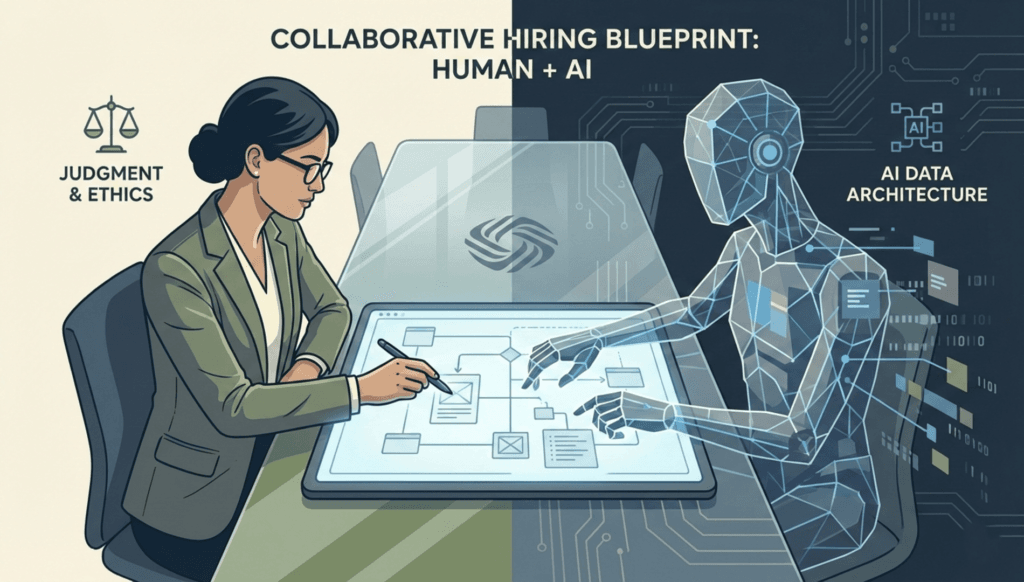
Recruitment Strategy 2026 marks a structural break from the past, not an incremental upgrade. In my experience, every decade brings new tools, but once in a generation, the rules themselves change. This is that moment. The relationship between humans and technology in hiring is being rebuilt, with artificial intelligence no longer positioned as support infrastructure but as an autonomous participant in the system itself. At the same time, skills, judgment, and organisational resilience are replacing credentials, job titles, and rigid hierarchies as the real currency of talent.
Leaders who continue to optimise yesterday’s recruitment models will struggle. Organisations that redesign for this new reality will gain a lasting advantage.
AI Breaks Through: Recruitment Strategy 2026 Elevates the Autonomous Hiring Partner
AI Crosses the Line from Tool to Autonomous Hiring Partner
The defining shift in Recruitment Strategy 2026 is the transformation of AI from a productivity aid into an autonomous hiring agent. This is not automation at the margins. It is a reallocation of decision-making power inside the recruitment workflow.
AI agents are now expected to manage entire segments of hiring with minimal human intervention. Screening, scheduling, candidate queries, compliance documentation, and workflow orchestration are no longer human-led activities supported by software. They are machine-run systems with humans overseeing outcomes. Up to 80 per cent of transactional recruitment activity is projected to be handled this way, fundamentally altering cost structures, speed, and scale.
More striking is the emergence of the AI Twin. Recruiters are building digital counterparts that operate continuously, updating systems, drafting communications based on historical patterns, and monitoring talent databases for changes. In practical terms, this frees more than half a workday every week for strategic work. In strategic terms, it creates parallel intelligence inside the organisation.
Perhaps the most consequential signal is belief. A majority of workers familiar with recruitment practices now expect AI to run the entire hiring process by the end of 2026. When perception shifts this decisively, adoption follows.
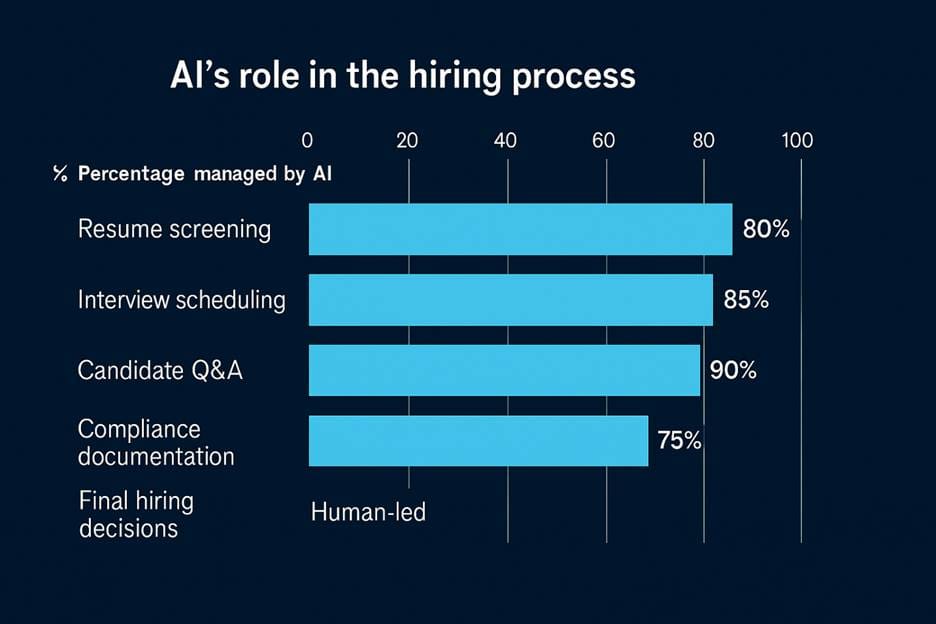
Share of Recruitment Activities Managed by AI (Projected)
Recruitment Strategy 2026 Recasts the Human Role: Strategic or Irrelevant
The Human Role Does Not Disappear. It Becomes Strategic or Irrelevant
When machines handle execution, humans must own judgment. Recruitment Strategy 2026 leaves no room for the traditional recruiter profile built around coordination, administration, and process management. Those tasks are now automated at scale.
What remains is the work only humans can do well — building trust with passive candidates, advising leaders on talent trade‑offs, designing roles that align capability with future business models, and interrogating AI output when it looks confident but wrong.
This shift demands an entirely new skill set. The recruiter must evolve into something broader, more adaptive, more strategically literate. A multiversed recruiter is becoming essential in talent acquisition, because versatility now shapes how organisations adapt, hire, and compete — a shift that elevates the role from process operator to strategic problem‑solver.
In my opinion, this is where many organisations will falter. Leaders assume AI fluency is the missing skill. Talent leaders, closer to the work, know the real gap is critical thinking. Humans must spot bias, detect hallucinations, and decide when to override algorithmic recommendations. Yet only a small minority of leaders believe their organisations are ready to manage hybrid human-AI teams effectively.
Managing people has always been complex. Managing people and machines together requires a new leadership approach.
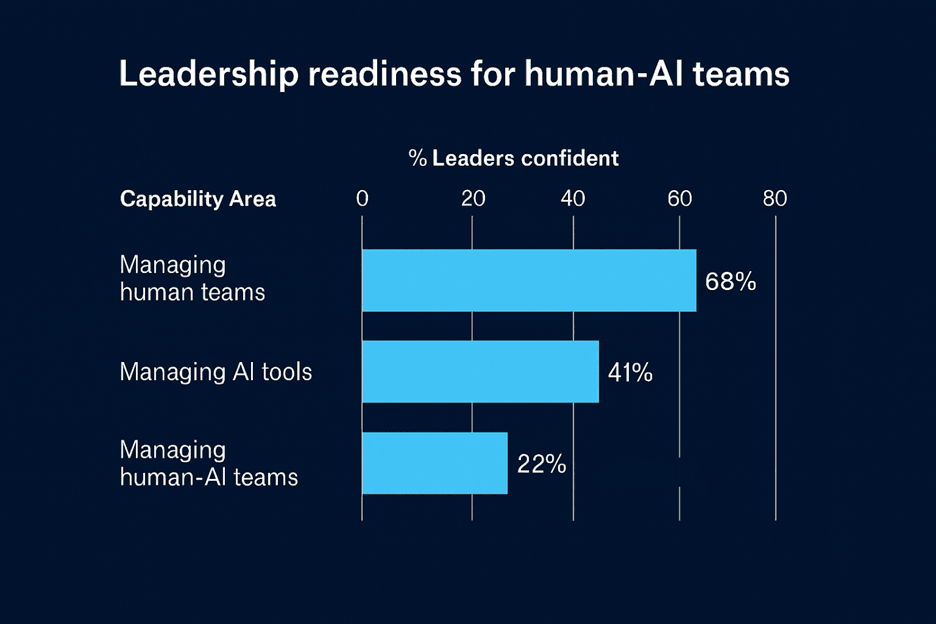
Leadership Readiness for Human-AI Teams
Recruitment Strategy 2026 Elevates Skills as the Backbone of Talent Strategy
Skills Replace Credentials as the Backbone of Talent Strategy
The Recruitment Strategy 2026 accelerates a shift that has been quietly building for years. Degrees, job titles, and linear career paths no longer predict performance. Skills, applied judgment, and learning velocity do.
Organisations are moving decisively toward skills-first hiring models, widening talent pools while reducing costly mis-hires. This is not ideological. It is economic. Skills-based hiring improves match quality and resilience at a time when roles evolve faster than job descriptions can keep up.
At the same time, assessment integrity is under pressure. Generative AI has made polished resumes and rehearsed interview answers universal. The signal-to-noise ratio has collapsed. Leaders must respond by redesigning assessments around lived experience, practical demonstrations, and problem-solving in context. The goal is not to ban AI use by candidates, but to test what AI cannot fake.
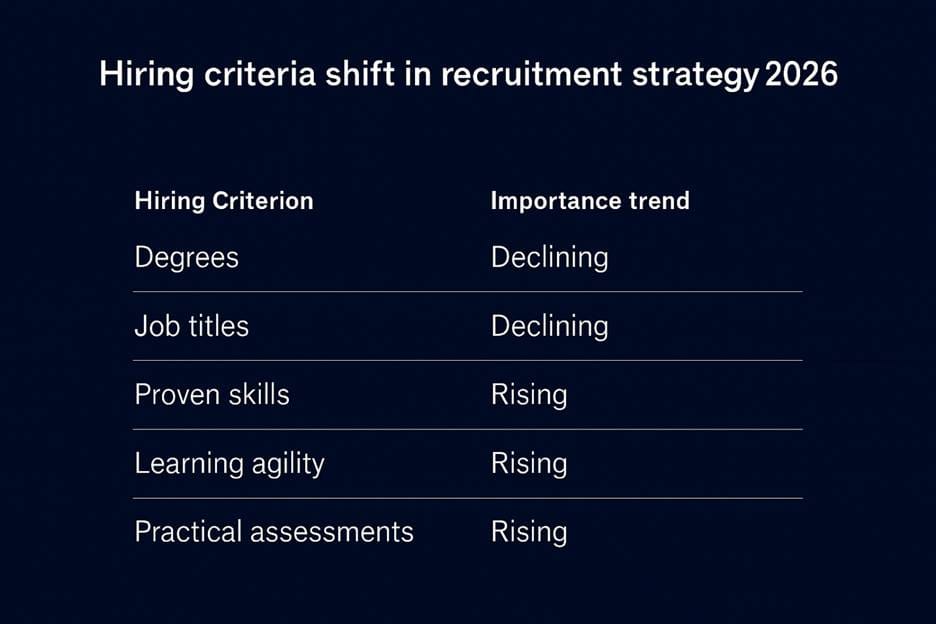
Hiring Criteria Shift in Recruitment Strategy 2026
Recruitment Strategy 2026 Confronts the Quiet Crisis in Entry-Level Talent Pipelines
Recruitment Strategy 2026 risks solving today’s costs while creating tomorrow’s shortage.
One of the least discussed consequences of Recruitment Strategy 2026 is the erosion of entry-level roles. As organisations replace junior and back-office positions with AI to cut costs, they eliminate the training ground where future leaders learn how the organisation actually works.
This is short-term optimisation with long-term consequences. Without entry-level pathways, organisations lose institutional memory, succession depth, and cultural continuity. They are then forced into expensive external hiring for senior roles, often importing capability without context.
In my experience, leadership pipelines do not fail suddenly. They decay quietly, then collapse under pressure.
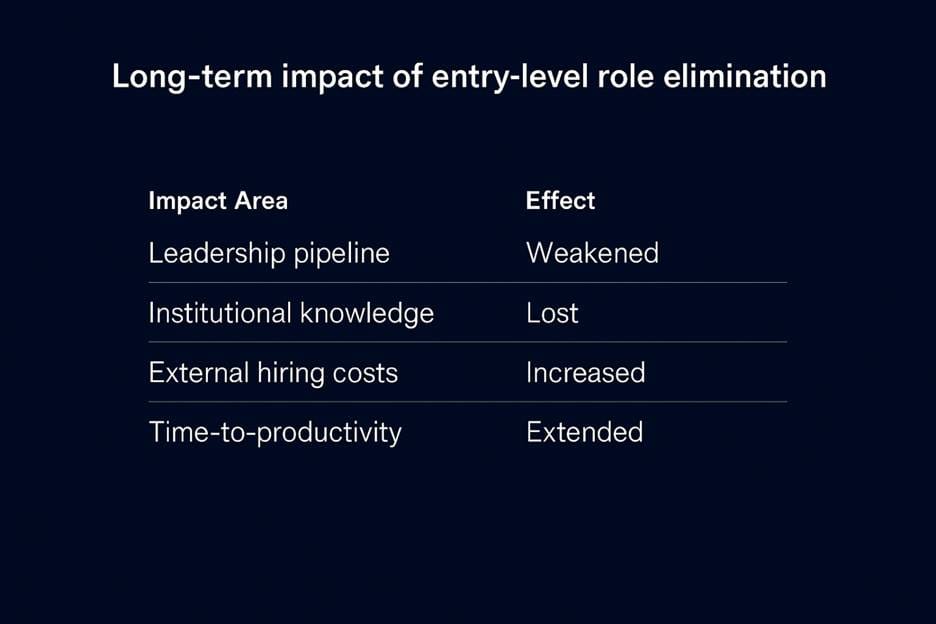
Long-Term Impact of Entry-Level Role Elimination
Candidate Experience Emerges as the Defining Constraint in Recruitment Strategy 2026
Recruitment Strategy 2026 treats experience as infrastructure, not branding.
In Recruitment Strategy 2026, candidate experience moves from employer branding rhetoric to operational necessity. Speed, transparency, and responsiveness now directly influence offer acceptance and talent access.
Candidates increasingly expect feedback within 48 hours. Delays are interpreted as disinterest or dysfunction. At the same time, pay transparency is becoming non-negotiable, driven by regulation and competitive pressure. Salary bands, progression frameworks, and equity disclosures are no longer optional signals of trust.
Return-to-office mandates further complicate the picture. Organisations that insist on rigidity shrink their talent pools and inflate compensation costs. Flexibility is no longer a perk. It is a market filter.
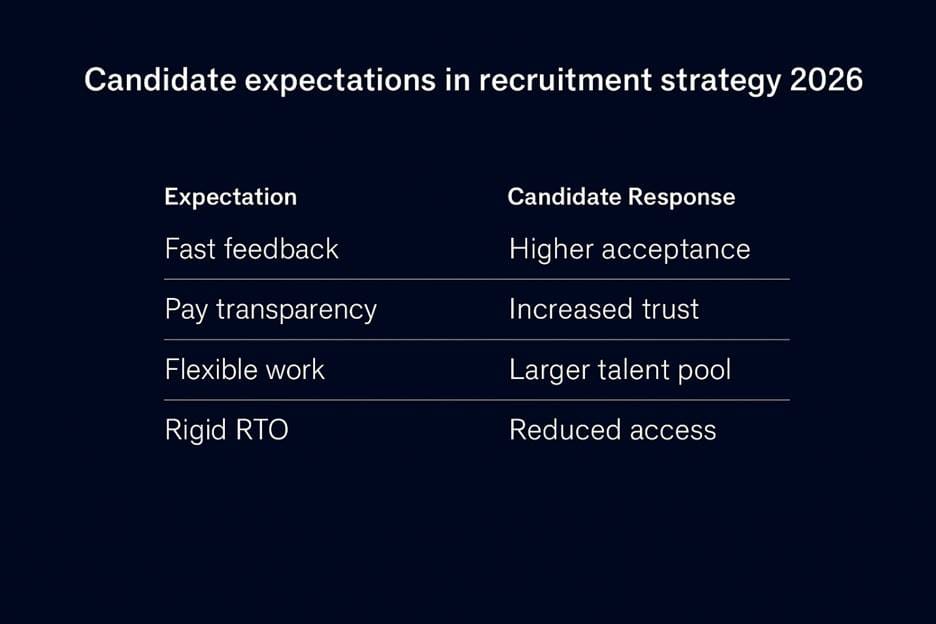
Candidate Expectations in Recruitment Strategy 2026
Recruitment Strategy 2026 Transforms Hiring Infrastructure with Modular Talent Models
Recruitment Strategy 2026 rewards adaptability over scale.
Economic uncertainty has exposed the inefficiency of fixed recruitment infrastructure. Recruitment Strategy 2026 favours modular models that scale capability up or down as needed. Short-term RPO partnerships, specialised external expertise, and flexible delivery models allow organisations to respond quickly without heavy capital investment.
This is not outsourcing for cost alone. It is architectural flexibility applied to talent.
Here’s What I Think
Recruitment Strategy 2026 is not about AI adoption. It is about organisational courage. Leaders must decide whether they are redesigning hiring for the future or automating the past.
AI will do the heavy lifting. Skills will replace credentials. Candidates will demand transparency and speed. The differentiator will be human judgment. Organisations that treat recruiters as strategic architects, not process managers, will win. Those that do not will move faster, cheaper, and in the wrong direction.
The future of hiring is already here. The only question left is who is willing to rebuild it.

is a Workforce & Resourcing Strategist with 28 years of experience across Oil & Gas, EPC, and project-driven engineering environments in India, the Middle East, and the Asia Pacific. Over his career, he has placed over 12,000 professionals and led resourcing strategies for Tier-1 global clients, including Saudi Aramco, ADNOC, Qatar Energy, ExxonMobil, BP, Chevron, Woodside, and TotalEnergies. He currently leads Talent Acquisition & Resourcing for India at a global EPC major, managing workforce strategy across a 16+ project portfolio spanning FEED, Detailed Engineering, and EPC phases. Through ajayable.com, Ajay shares field-tested thinking on workforce strategy, delivery risk, skills-first hiring, AI in recruitment, and contract workforce management — grounded in real project environments rather than theory. Connect with him on LinkedIn.
Leave a Reply