• Skip to primary navigation
  • Skip to main content
  • Skip to primary sidebar
  • Privacy Policy
  • Terms and Conditions
  • Contact

ajayable

Your Guide to Smarter Hiring and HR Excellence.

  • Home
  • Discover Talent Trends
    • Recruitment Market Trends
    • Talent Acquisition Strategies
    • AI & Automation in Recruitment
    • Technical HR
    • Leadership & Workforce Strategy
    • Career Development for HR Professionals
  • Trending Insights
    • Global Hiring Trends: Seizing Opportunities for Workforce Evolution
    • Navigating the Recruitment Frontier: Top Talent Trends Shaping 2025 and Beyond.
    • AI in Talent Acquisition: Revolutionizing Recruitment for 2025 and Beyond.
    • Beyond the Cubicle: The Future of Work is Flexible
    • AI in HR: A Strategic Framework for Digital Transformation.
  • About Ajay
Home » Leadership & Talent Strategy

Leadership & Talent Strategy

The Hollow Organisation: Why 2026 Cost-Cutting Triggers a Leadership Pipeline Crisis by 2030

January 20, 2026 by ajay dhage Leave a Comment

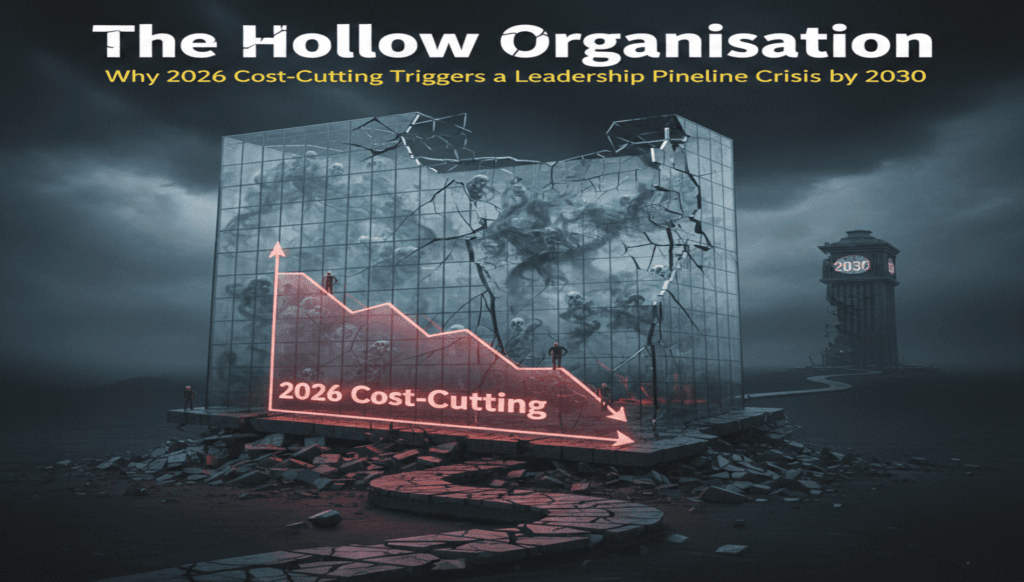
The Hollow Organisation: Why 2026 Cost-Cutting Triggers a Leadership Pipeline Crisis by 2030

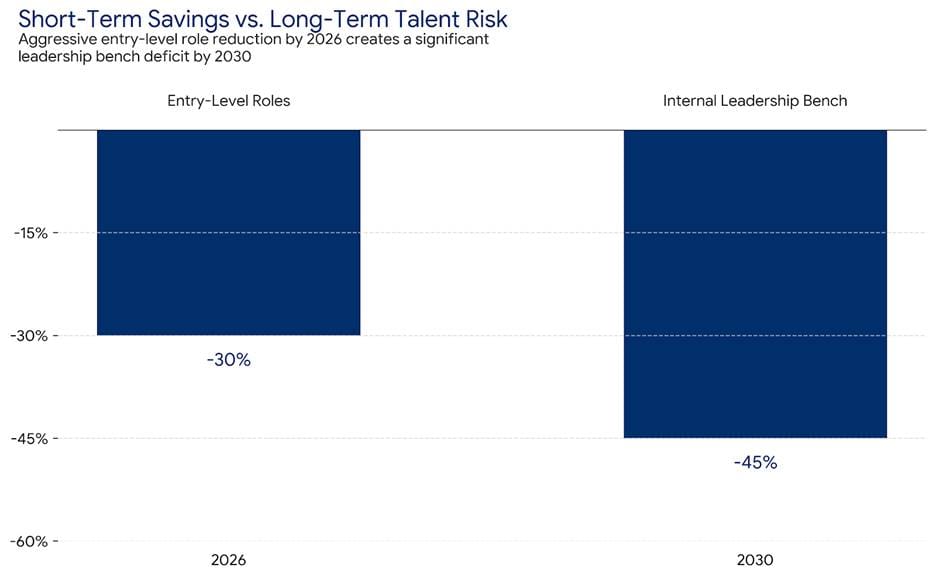
In 2026, boardrooms will applaud efficiency. Leaders will point to payroll reductions, automated workflows, and short-term margin gains. The Leadership Pipeline Crisis begins here. I believe many organisations mistake financial neatness for strategic strength. By stripping out entry-level roles in pursuit of cost control, companies hollow out the very system that produces future leaders. What looks disciplined today sets up operational fragility tomorrow.

The numbers seduce. Sixty four percent of executives plan AI-driven headcount reductions, with junior and back-office roles first on the list. These positions appear expendable. In my opinion, they represent the apprenticeship layer of leadership. Remove the base, and the pyramid collapses. If entry-level employees vanish in 2026, who will carry institutional memory in 2030?

Short-Term Savings Create Long-Term Leadership Risk

Efficiency wins budgets. Talent debt destroys futures.

Boards reward fast results. Replacing junior roles with automation trims millions from operating costs. Research shows forty three percent of firms plan to replace roles with AI, targeting operations and entry-level staff. The Leadership Pipeline Crisis hides behind these numbers.

Every senior leader once started in those roles. Eliminate the entry point, and the journey ends before it begins. I believe modern efficiency misses a basic truth. The coordinator who understands every workaround becomes the manager who stabilises chaos. When the coordinator disappears, the feeder system fails. A balance sheet shows savings. The organisation absorbs structural damage.

Short-term savings vs, long term talent risk

Entry-Level Roles Anchor Institutional Knowledge

Leadership forms through exposure, not instruction.

Institutional knowledge lives outside manuals. It passes through observation, repetition, and context. Entry-level employees absorb how decisions get made, who influences outcomes, and where risks hide. This learning underpins the Leadership Pipeline Crisis.

David Ellis of Korn Ferry warns against halting junior hiring. Early-career professionals adopt technology faster than any other group. They translate tools into practice. When organisations cut these roles, competitors who retain them move faster. Agility follows people, not software.

Without internal pipelines, firms buy leadership externally. External hires cost more, integrate more slowly, and lack cultural context. Is a million saved today worth five million in search fees and failed transitions later? I believe most boards never run this math.

AI Agents Accelerate the Leadership Pipeline Crisis

Automation removes the work that teaches judgment.

By 2026, AI agents stop assisting and start operating. Entire workflow segments run without human intervention. Up to eighty per cent of transactional recruitment and administrative activity shifts to machines. This marks an inflexion point in the Leadership Pipeline Crisis.

AI twins free fifteen hours per employee each week. Productivity rises. Learning opportunities shrink. In my experience, administrative work trains professional instinct. Scheduling interviews teaches stakeholder dynamics. Resume screening teaches pattern recognition. When machines absorb this work, junior employees lose the training ground where judgment forms.

The result is not fewer people. It is fewer people with seasoned judgment.

The Skills Gap Widens the Leadership Pipeline Crisis

Technical fluency grows faster than human capability.

Sixty three percent of employers identify the skills gap as the main barrier to transformation through 2030. Here lies the paradox. AI-led job cuts widen the very gap leaders fear.

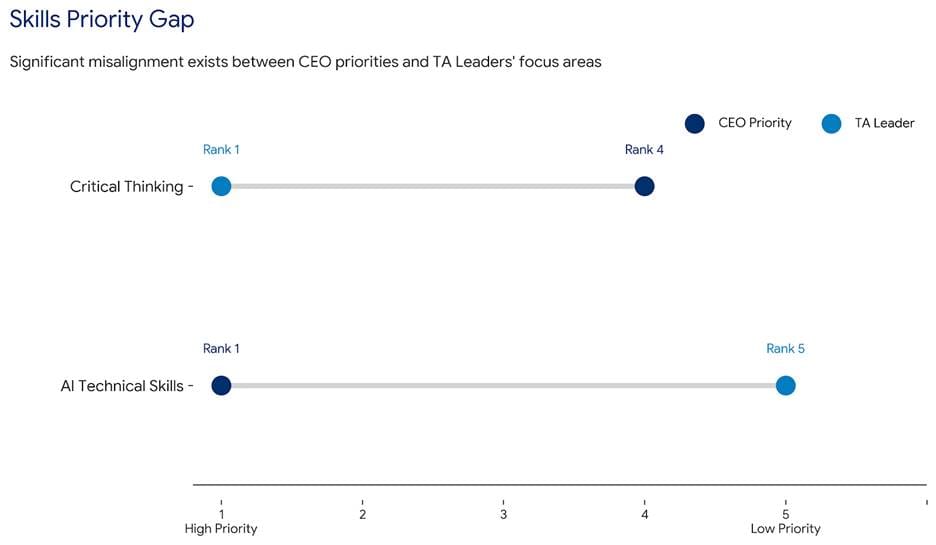
Executives chase AI expertise. Talent leaders prioritise critical thinking and problem-solving. Technical skills rank fifth. Why? Tools teach fast. Judgment develops slowly. Anyone learns prompting in weeks. Questioning output takes years.

A workforce fluent in tools but weak in evaluation fuels the Leadership Pipeline Crisis. When leaders lack the instinct to challenge machine output, risk multiplies.

Leadership Pipeline Crisis :Skills priority gap

Boomer Retirements Drain Leadership Capacity

Experience exists as apprentices disappear.

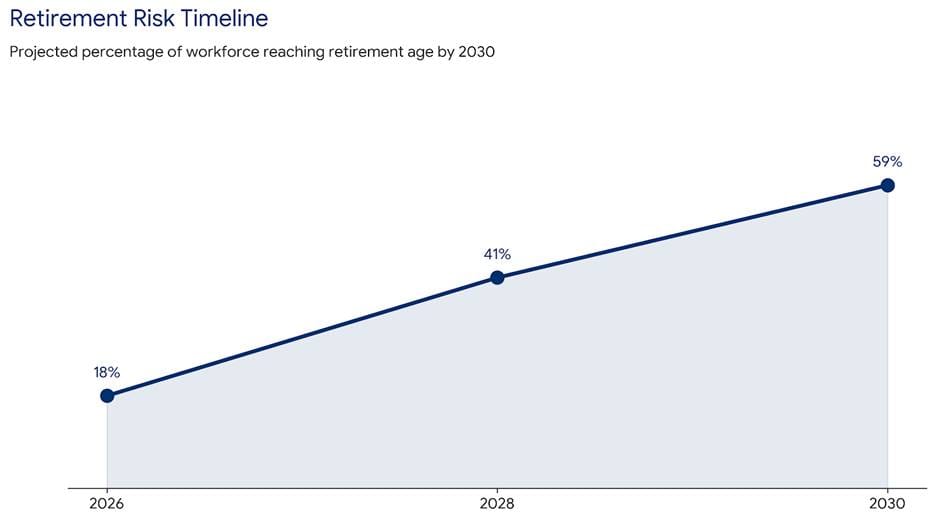
Retirements accelerate in 2026. Fifty nine percent of workers over fifty-five plan to retire within five years. Seventy two percent of managers fear losing critical expertise. The Leadership Pipeline Crisis intensifies from both ends.

Experienced mentors exit. Entry-level mentees never arrive. Knowledge transfer collapses. I believe organisations miss a simple buffer. Short-term rehiring of retirees buys time. It enables mentoring, documentation, and succession. Cost obsession blocks patience. The bridge collapses from both sides.

Leadership Pipeline Crisis :Retirement risk timeline

Redesigning Roles to Protect the Leadership Pipeline

Human work must evolve, not vanish.

The answer lies in redesign, not resistance. Organisations must stop eliminating junior roles and start reshaping them. AI handles routine tasks. Humans practice judgment, advisory work, and relationship management.

Return on investment must include biological return. If automation saves fifteen hours weekly, leaders must reinvest those hours into complex decision-making. Talent acquisition shifts from a cost centre to a strategic capability.

In my opinion, firms that survive the Leadership Pipeline Crisis treat early-career hiring as precision development, not volume intake.

Skills-First Hiring Strengthens the Leadership Pipeline

Ability outperforms pedigree.

Degrees lose dominance. Only forty one percent of job seekers view degrees as essential. Skills-first hiring expands access and accuracy.

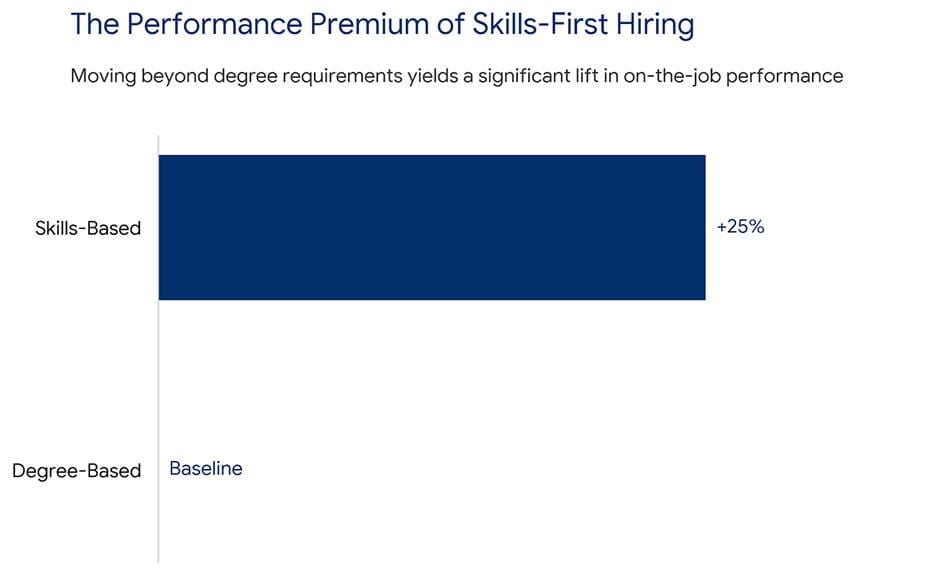
Ninety per cent of firms using skills-based hiring report fewer hiring mistakes. Ninety four percent see stronger performance. Skills verification now happens instantly through digital credentials. Ability replaces background.

I believe skills-first hiring stands as a structural defence against the Leadership Pipeline Crisis. Future leaders solve problems. Credentials are never guaranteed.

Leadership Pipeline Crisis :The performance premium of skills-first hiring

Internal Mobility Builds Leadership Capacity

The next leader already works inside.

External markets fluctuate. Internal capability compounds. Fifty one percent of employers plan to redeploy talent internally. The Leadership Pipeline Crisis often reflects imagination failure.

Internal talent marketplaces reveal transferable skills. AI supports matching and learning pathways. Careers shift from ladders to networks. When organisations invest in growth, employees invest in outcomes.

If leaders of 2030 cannot be hired, they must be built.

Data Storytelling Makes the Leadership Pipeline Visible

Boards respond to evidence, not warnings.

Recruitment success no longer rests on time-to-fill. It rests on impact. Talent leaders must prove performance, retention, and revenue contribution.

Quality of hire declines when automation dominates. Cost-per-hire improves. Boards see one metric and miss the risk. In my opinion, the Leadership Pipeline Crisis persists because boards track the wrong signals. Ultimately, predictive analytics and human judgment will decide who wins. 

Leaders who connect hiring data to business outcomes secure sponsorship and budget.

Human and AI Teams Demand New Leadership

The challenge shifts from technology to trust.

Hybrid teams define 2026. Yet only twenty two percent of leaders trust managers to lead humans and AI together. This gap feeds the Leadership Pipeline Crisis.

Managers must know when to override machines, manage conflict, and coordinate mixed teams. AI-ready leaders translate strategy into execution. Software equalises access Human judgment differentiates outcomes. Ultimately, it is the human edge—essential capabilities, not AI—that will define the future of work. 

Here’s What I Think

The next five years belong to workforce orchestrators. Talent leaders’ step beyond operations into strategic authority. Those who reclaim time through AI become advisors on transformation.

But hollow organisations fail regardless of technology. Eliminating entry-level roles for margin equals corporate cannibalism. The future gets consumed to fund the present.

I believe the human machine frontier demands a new idea. Silicon mentorship. AI should capture retiring knowledge and train early-career talent. Apprenticeship programs should hire a junior human and an AI agent together.

Ground these actions now:

  1. Replace headcount reduction with talent elevation. Reinvest automation savings into reskilling.
  2. Test critical thinking in every interview. Machines handle proficiency.
  3. Redesign entry-level roles into specialised tracks from day one.
  4. Quantify the Leadership Pipeline Crisis. Show boards when leadership supply collapses.

The future of work is not speed. It is structured. Leadership in 2030 depends on which organisations develop today. Software scales. People decide.


ajay dhage

Ajay Dhage is a seasoned talent acquisition leader with over 20 years of experience in Talent Acquisition and Workforce Strategy across the oil and gas, EPC, and renewables sectors. As Talent Acquisition Lead for a global Oil & Gas EPC company in India, he manages the end-to-end hiring lifecycle for complex, multi-disciplinary projects, from sourcing and assessment to onboarding and workforce planning. Known for his customer-focused approach and innovative use of AI and data in hiring, Ajay focuses on building future-ready workforces and resilient leadership pipelines. Through ajayable.com, he shares insights, trends, and practical frameworks to help HR professionals, organisations, and recruiters excel in a rapidly evolving, competitive talent landscape.
ajayable.com

Filed Under: Leadership & Talent Strategy, Leadership & Workforce Strategy Tagged With: employee retention, recruitment trends, talent shortage solutions, Workforce planning

Beyond Hiring: Sculpting the Workforce of Tomorrow

December 9, 2024 by ajay dhage 2 Comments

future workforce development

In today’s hyper-competitive business landscape, talent acquisition has evolved from an operational necessity to a strategic imperative. Future workforce development is no longer just about hiring the best candidates; it’s about constructing a resilient workforce capable of driving innovation, adapting to change, and sustaining organizational growth. This new paradigm emphasizes the importance of developing skills and attributes that align with the ever-changing demands of the market, ensuring that organizations remain agile and competitive.

As someone deeply invested in this field, I’ve seen firsthand how the rules of recruitment are evolving. Traditional approaches, though foundational, no longer suffice. The focus has shifted toward building dynamic talent pipelines, leveraging cutting-edge technology, and crafting employer brands that stand out in the crowded labour market. But what does this mean for organizations, and how can they adapt? How can we effectively develop the workforce of the future?

Redefining Talent Acquisition: A Holistic Approach

Talent acquisition today transcends the simple act of filling vacancies. It’s about aligning recruitment efforts with overarching business goals to drive future workforce development. Companies must think beyond the immediate needs and strategically plan for the future. This requires a comprehensive framework built on five interconnected pillars, each critical for the success of future workforce development.

1. Strategic Workforce Planning: The Chess Master’s Perspective

Successful talent acquisition starts with an intimate understanding of organizational goals and workforce requirements. It’s not enough to respond to current needs; companies must anticipate the future. Strategic planning involves mapping out hiring forecasts based on growth objectives, technological advancements, and market trends.

For example, as industries embrace automation and artificial intelligence, roles like data scientists, automation specialists, and AI ethicists are no longer optional—they’re indispensable. Companies that plan for these shifts by identifying future skill requirements and nurturing relationships with potential candidates gain a significant edge over competitors​.

2. The Magnetism of Employer Branding

In a world inundated with choices, a strong employer brand can make all the difference. It’s about telling a story—a compelling narrative that showcases your company’s culture, values, and vision. When Bhavish Aggarwal, CEO of Ola, visits India’s top campuses, he’s not just scouting talent; he’s reinforcing the idea that Ola is the place for visionaries​.

A robust employer brand serves as a beacon, attracting candidates who align with your ethos. But branding isn’t just external. Your existing employees are your most potent ambassadors. Their testimonials, whether shared on social media or through informal networks, carry immense credibility.

3. Diversity and ESG: Foundations for a Modern Workforce

Diversity and inclusion are no longer optional—they’re essential. Research consistently shows that diverse teams are more innovative and better equipped to solve complex problems. But diversity isn’t just about representation; it’s about creating an environment where everyone can thrive.

This is where Environmental, Social, and Governance (ESG) initiatives come into play. Younger generations, particularly Gen Z, value employers who prioritize sustainability and social impact. Companies aligning their benefits and policies with ESG principles—such as offering eco-friendly commute incentives or transparent pay structures—find themselves better positioned to attract top talent​.​

4. Harnessing the Power of Technology

Technology is the silent workhorse of modern talent acquisition. From AI-driven sourcing tools that identify high-potential candidates to applicant tracking systems that streamline the recruitment process, technology has revolutionized how companies approach hiring.

Consider this: a mid-sized organization processing thousands of applications can save hundreds of hours using automation. But technology’s role goes beyond efficiency. Predictive analytics can help forecast candidate success, while machine learning algorithms can identify biases in job descriptions, promoting inclusivity​.

5. Crafting Unforgettable Candidate Experiences

In a competitive job market, the candidate experience can make or break your hiring strategy. A clunky application process or lack of communication can turn potential hires away faster than you can say “talent shortage.”

On the flip side, companies that prioritize seamless, transparent interactions create a lasting impression. Timely feedback, clear timelines, and even small gestures like personalized thank-you notes can elevate the candidate experience and enhance your employer brand​..

Navigating the Challenges of a Tight Labor Market

The labor market is tighter than a drum, with vacancies often outstripping available talent. Aging populations, rapid technological advancements, and shifting worker priorities have created a perfect storm. This is particularly evident in high-demand sectors like healthcare and technology, where finding skilled professionals feels like searching for a needle in a haystack​.

Moreover, younger workers bring their own set of expectations. For them, work isn’t just about a paycheck—it’s about purpose, flexibility, and alignment with personal values. This shift has sparked movements like the “Great Resignation,” where employees are leaving roles in search of more meaningful work​.

Winning the Talent Wars: Six Proven Strategies

So, how can organizations turn these challenges into opportunities? Here are six actionable strategies:

1. Build Holistic Compensation Packages

Compensation is no longer limited to salaries. Think of benefits like remote work options, wellness programs, and professional development opportunities. These extras often tip the scales in your favor​.

2. Embrace Leadership Involvement

CEOs like Deepinder Goyal of Zomato demonstrate that personal involvement in hiring sends a powerful message. It signals to candidates that the company values its talent as much as its bottom line​.

3. Cultivate a Talent Pipeline

Networking isn’t just for salespeople. Attend industry events, engage with talent on social media, and maintain relationships with potential hires long before a vacancy arises​.

4. Promote Diversity Proactively

Review your hiring practices to eliminate bias, craft inclusive job descriptions, and ensure interview panels reflect the diversity you aim to achieve​.

5. Optimize with Data

Track metrics like time-to-hire and quality-of-hire to continuously refine your recruitment strategies. Data is your compass in the often-chaotic world of hiring​.

6. Invest in Technology

From chatbots that guide candidates through applications to analytics that predict hiring outcomes, technology is your secret weapon​.

Future Workforce Development: The Road Ahead

Talent acquisition is no longer a support function—it’s a strategic driver of organizational success. Companies that embrace its transformative potential will find themselves ahead of the curve, armed with a workforce ready to tackle future challenges.

In my opinion, the key lies in adaptability. Whether it’s embracing new technologies, redefining leadership roles, or fostering diversity, the ability to evolve will separate the winners from the also-rans. So, what’s your next step in this journey? Let’s connect and brainstorm how to future-proof your talent acquisition strategy.

Reference

AiGroup: How talent acquisition is shaping the future of recruitment

Ius Laboris: Workforce of the future: Attracting and retaining talent in a changing labour market.

Storyboard18: Hiring 2.0: How India’s CEOs are leveraging social media and campus tours to attract talent.

ajay dhage

Ajay Dhage is a seasoned talent acquisition leader with over 20 years of experience in Talent Acquisition and Workforce Strategy across the oil and gas, EPC, and renewables sectors. As Talent Acquisition Lead for a global Oil & Gas EPC company in India, he manages the end-to-end hiring lifecycle for complex, multi-disciplinary projects, from sourcing and assessment to onboarding and workforce planning. Known for his customer-focused approach and innovative use of AI and data in hiring, Ajay focuses on building future-ready workforces and resilient leadership pipelines. Through ajayable.com, he shares insights, trends, and practical frameworks to help HR professionals, organisations, and recruiters excel in a rapidly evolving, competitive talent landscape.
ajayable.com

Filed Under: Leadership & Talent Strategy Tagged With: future workforce, leadership development, reskilling, succession planning, talent innovation, talent strategy, upskilling, Workforce planning

Primary Sidebar

Latest Reads

  • The Hollow Organisation: Why 2026 Cost-Cutting Triggers a Leadership Pipeline Crisis by 2030
  • Recruitment Strategy 2026: Why AI, Skills, and Human Judgment Will Redefine Hiring
  • Workforce Readiness: How AI-Driven Organisations Are Redefining Hiring for the Future
  • Skilled Trades Innovators: The Great Career Pivot and What Leaders Must Do Next
  • Degrees Without Direction: Solving the India Career Guidance Crisis

What Readers Say

  1. ajay dhage on Talent Wars: Winning the Battle for Top Employees
  2. Raosaheb P Pandit on Talent Wars: Winning the Battle for Top Employees
  3. Vipul Patel on How Evolving Degree Value is Redefining Career Pathways
  4. Deep Punkar on How Evolving Degree Value is Redefining Career Pathways
  5. Malini S on Gen Z Employability in India: Decoding Why Indian Companies Are Hesitant to Hire

Explore Topics

  • AI & Automation in Recruitment
  • AI & Automation in TA
  • AI and Automation
  • AI in Recruitment
  • Campus & Early Careers
  • Career Development for HR Professionals
  • Future of Work
  • Industry Trends
  • Leadership & Talent Strategy
  • Leadership & Workforce Strategy
  • Recruitment Market Trends
  • Talent Acquisition Strategies
  • Technical HR

Archives

  • January 2026
  • December 2025
  • November 2025
  • October 2025
  • September 2025
  • June 2025
  • May 2025
  • April 2025
  • March 2025
  • February 2025
  • January 2025
  • December 2024

Copyright © 2026 · News Pro on Genesis Framework · WordPress · Log in